The Wheel of Harmony — Explorers Edition (Ages 7–12)
The Wheel of Harmony — Explorers Edition (Ages 7–12)
A guide for parents and young learners, based on the Wheel of Harmony.
For Parents & Educators
The Developmental Shift
Between seven and twelve, something fundamental changes. The child moves from sensory-narrative immersion into conceptual reasoning. They can categorize, compare, self-reflect, and — critically — they can begin to diagnose their own life. “I’ve been on screens all week and haven’t been outside” is a statement a nine-year-old can make, and it is a diagnostic act. The Wheel becomes a tool they can use, not just a pattern they absorb.
This is the late Beginner (Śiṣya) to early Intermediate (Sādhaka) transition described in Harmonic Pedagogy. The child has internalized basic structures and begins practicing with increasing independence. Your role shifts from environment-provider to guide — offering feedback, posing harder questions, and gradually releasing control.
What Changes from the Seedlings Version
The petals become pillars with their real names: Presence, Health, Matter, Service, Relationships, Learning, Nature, Recreation. The flower becomes a heptagon — a map with geometry, not just color and shape. The center is named: Presence is “the part of you that notices everything else.” And the child is now invited to self-assess: “How is your Wheel looking this week?”
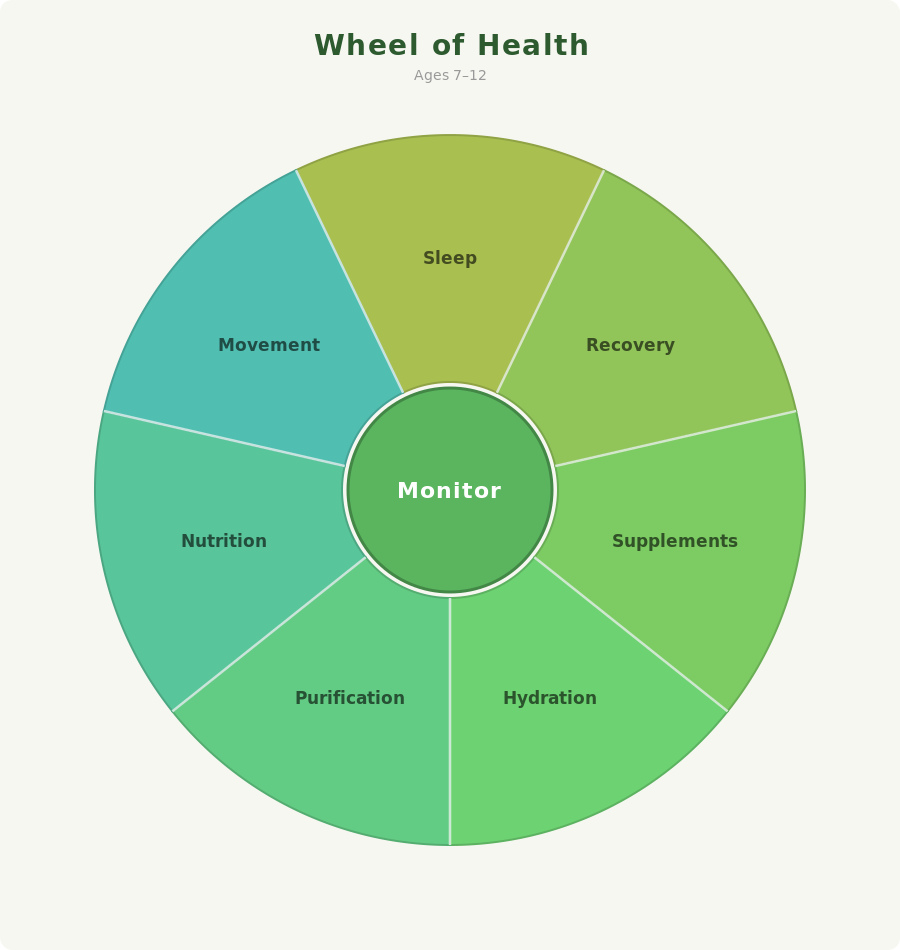
The sub-wheels are introduced lightly at this stage. “Health has its own wheel too — it has seven parts: Sleep, Recovery, Supplementation, Hydration, Purification, Nutrition, and Movement. Which of those is strongest for you? Which one needs attention?” The fractal depth is not unpacked philosophically, but the child begins to see that each domain has its own internal structure.
What Makes This Work: Presence and Love
The shift from Seedlings to Explorers changes the method — from sensory immersion to conceptual reasoning — but it does not change the foundation. Your Presence remains the master variable. The quality of a diagnostic conversation depends less on the question you ask than on the consciousness from which you ask it. A parent operating from genuine presence and curiosity opens a space the child can think inside. A parent operating from anxiety about performance closes it.
And Love — the center of the Wheel of Relationships — remains the center of this educational relationship. The Explorer-age child is developing the capacity for self-assessment, which requires a specific relational condition: the child must feel safe enough to be honest about weakness. If the Wheel check-in becomes a performance review rather than an act of shared attention, the diagnostic power collapses. The child tells you what they think you want to hear instead of what is true. Love — the active practice of caring deeply without judgment — is what keeps the space honest.
How to Use the Explorers Wheel
Weekly Wheel Check-In. Set aside 10–15 minutes once a week (Sunday evening works well) for a Wheel review. The child rates each pillar on a simple scale: strong, okay, or needs attention. No numbers, no precision — just honest self-observation. Over time, patterns emerge. “I always forget Nature” or “Service is always low for me” becomes visible.
Diagnostic Conversations. When something feels off but the child cannot name it, the Wheel provides the vocabulary. “Let’s look at your Wheel — where does the tightness live?” Is it Health (sleep debt, poor nutrition)? Relationships (conflict with a friend)? Learning (boredom, understimulation)? The Wheel turns vague unease into actionable diagnosis.
Activity Integration. Help the child see that a single activity can serve multiple pillars. A family hike is Nature + Health + Relationships + Recreation. Cooking dinner together is Health + Matter + Service + Learning. A chess game is Learning + Recreation. The Wheel is not about equal time per pillar — it is about awareness. Merging activities across pillars is mastery, not exception.
The Journal. If the child is a writer, a simple Wheel journal can be powerful: one page per week, with all eight pillars listed (Presence as central pillar plus the seven peripheral pillars) and a sentence or two for each. What happened? What was missing? What do I want more of? This builds the reflective habit that Presence requires.
Sub-Wheel Reference (Parent Diagnostic Tool)
Each pillar unfolds into its own seven-part wheel with a center principle. At the Explorer stage, you can introduce these when a pillar needs deeper attention:
| Pillar | Center | The Seven Parts |
|---|---|---|
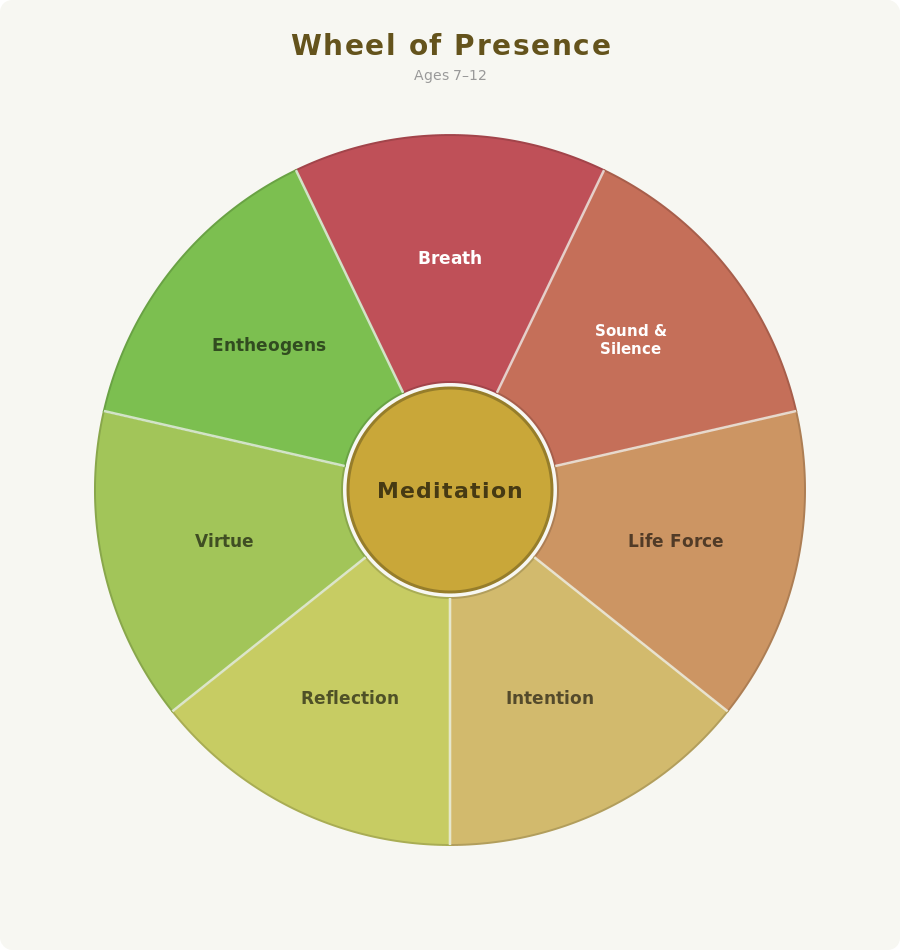
| Presence | Meditation | Breath, Sound & Silence, Life Force, Intention, Reflection, Virtue, Entheogens |
| Health | Monitor | Sleep, Recovery, Supplementation, Hydration, Purification, Nutrition, Movement |
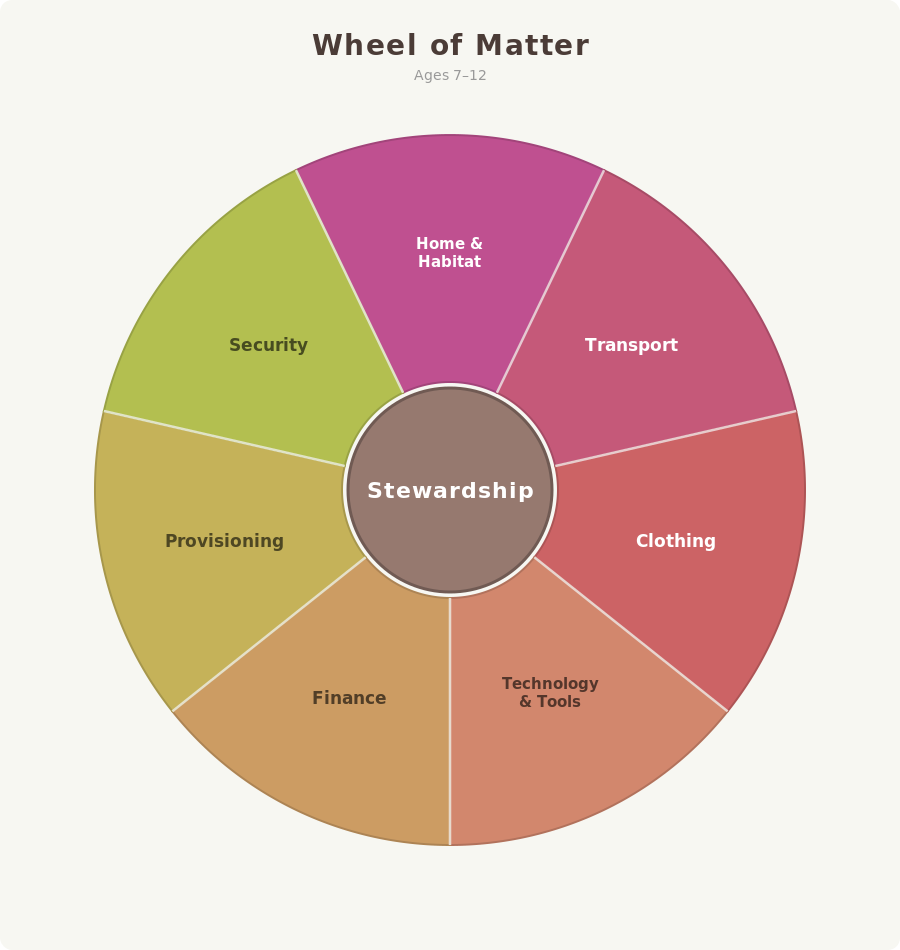
| Matter | Stewardship | Home, Transport, Clothing, Technology, Finance, Provisioning, Security |
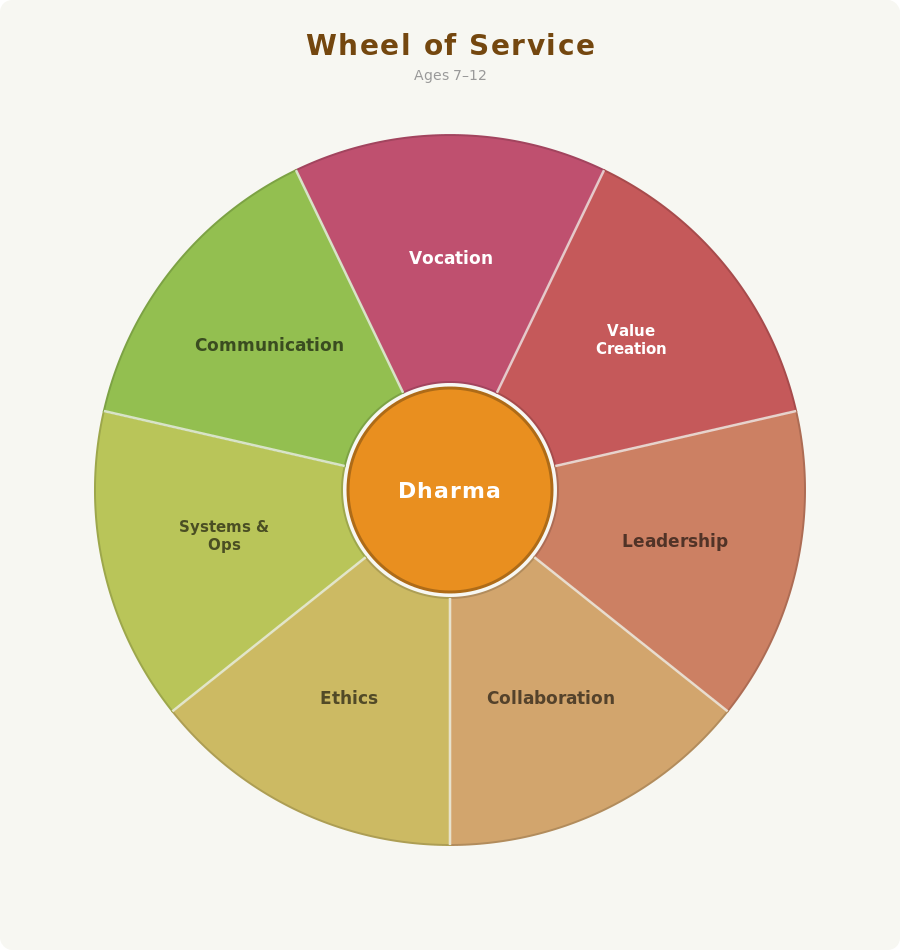
| Service | Dharma | Vocation, Value Creation, Leadership, Collaboration, Ethics, Systems, Communication |
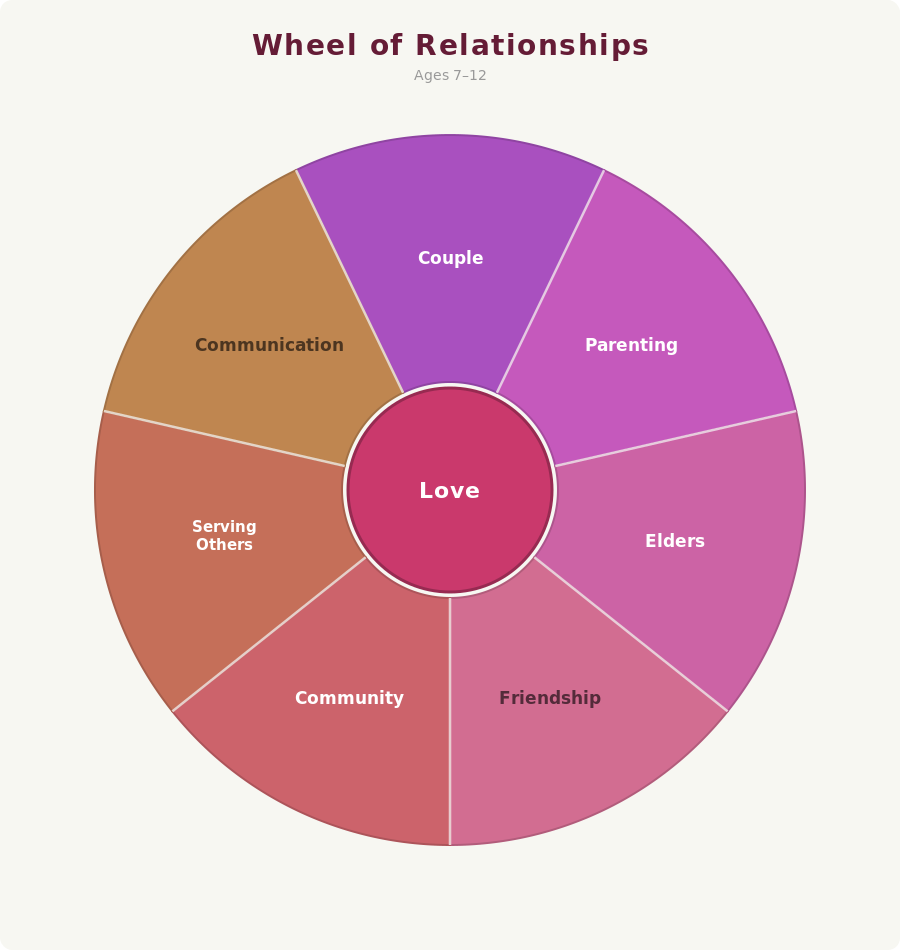
| Relationships | Love | Couple, Parenting, Elders, Friendship, Community, Serving Others, Communication |
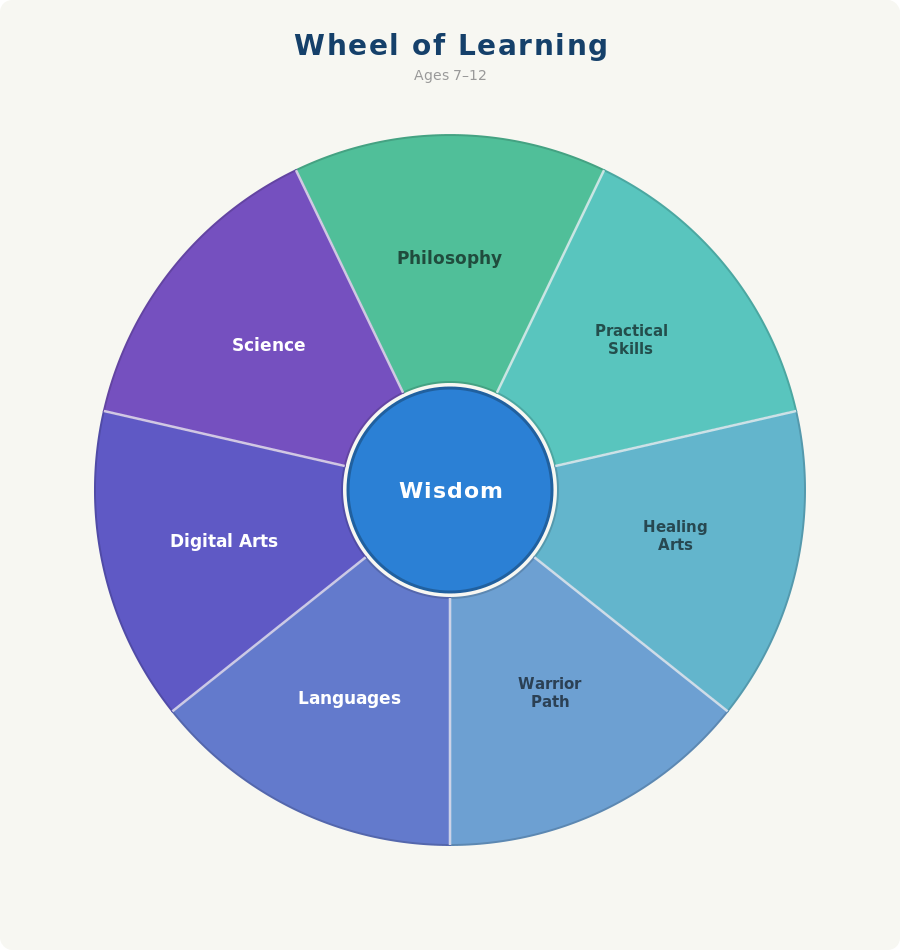
| Learning | Wisdom | Philosophy, Practical Skills, Healing Arts, Warrior Path, Languages, Digital Arts, Science |
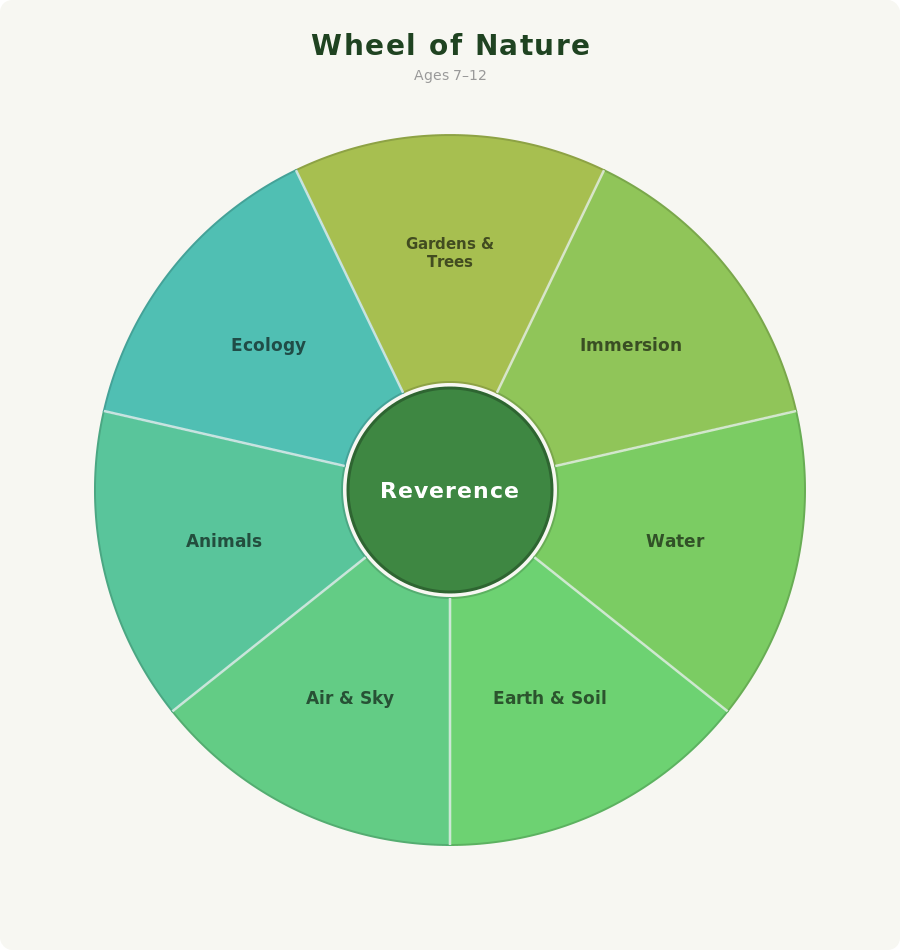
| Nature | Reverence | Gardens & Trees, Immersion, Water, Earth & Soil, Air & Sky, Animals, Ecology |
| Recreation | Joy | Music, Visual Arts, Narrative Arts, Sports, Games & Play, Travel, Gatherings |
Note: “Entheogens” (sacred plant medicine) is included for structural completeness. At this age, the appropriate framing is simple: some plants have been used in sacred ceremonies by cultures around the world, and they are never used casually or without guidance. This is a seed for later understanding, not a call to action.
Developmental Markers
By the end of this stage, a child who has worked with the Explorers Wheel should be able to:
- Name all eight pillars (Presence as central pillar + seven peripheral pillars) and explain each in their own words
- Conduct a self-assessment and identify which pillars need attention
- Understand that each pillar has its own sub-wheel (without needing to know all categories)
- Recognize when activities serve multiple pillars simultaneously
- Sit in meditation or quiet reflection for 5–10 minutes with some stability
- Begin to articulate what they care about most deeply (early Dharma awareness)
For the Explorer
What Is the Wheel of Harmony?
Imagine you could see your whole life on one page — not just school or sports or friends, but everything that matters. That is what the Wheel of Harmony does. It is a map of a complete human life, and it has eight parts.
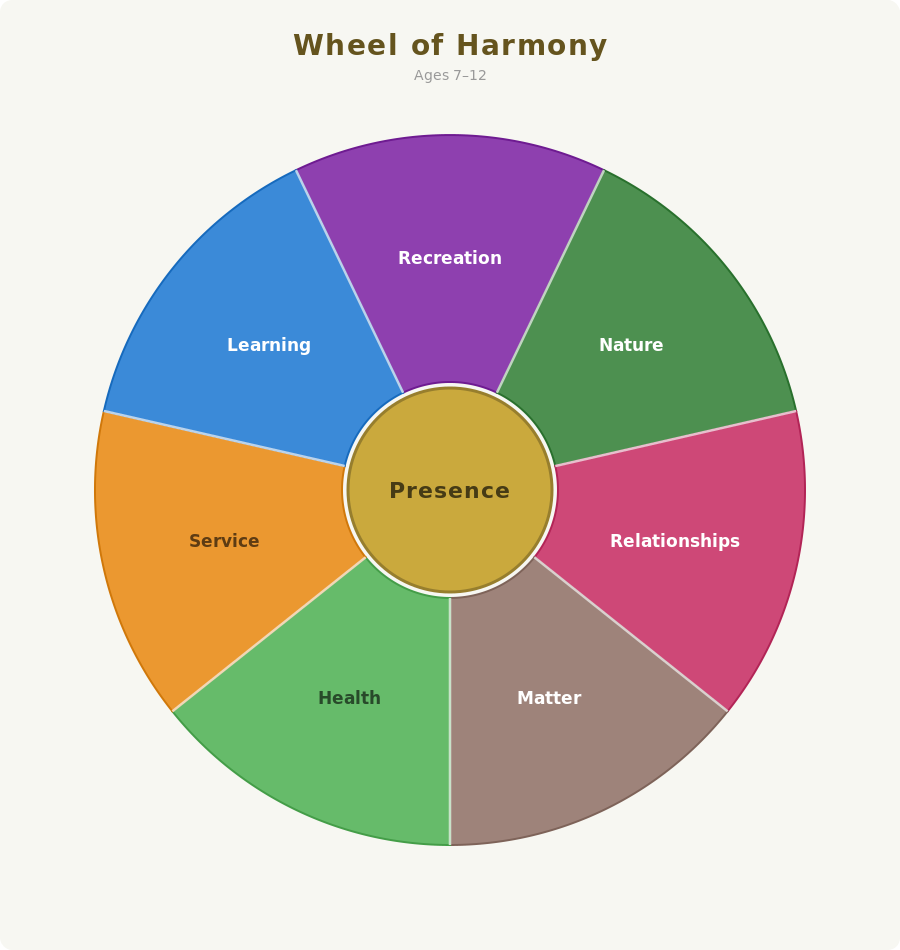
At the center is Presence — the quiet, aware part of you that notices everything else. It is not one thing you do; it is the way you do everything. When you eat breakfast and actually taste the food instead of staring at a screen, that is Presence. When you listen to a friend and really hear them, that is Presence. When you sit still and notice your breathing, that is Presence. It is always available, but it takes practice to stay there.
Around the central pillar of Presence are seven peripheral pillars, each representing a dimension of your life:
Health — Your body, your energy, your vitality. Sleep, food, water, movement, recovery. The center of Health is Monitor — paying attention to how your body feels, what it needs, and what it is telling you.
Matter — The physical world around you: your home, your belongings, your tools, your money. The center of Matter is Stewardship — taking care of what you have, not just consuming it.
Service — How you contribute, help, and create value for others. This is not just chores — it is finding the thing you are meant to do in the world. The center of Service is Dharma — your unique purpose.
Relationships — The people in your life: family, friends, community. The center of Relationships is Love — not just the feeling, but the practice of caring deeply and acting on it.
Learning — Everything you study, discover, practice, and master. Not just school subjects — philosophy, practical skills, healing, languages, science, digital arts. The center of Learning is Wisdom — not just knowing facts, but understanding what they mean.
Nature — Your relationship with the living world: plants, animals, water, earth, sky. The center of Nature is Reverence — approaching the natural world with respect and wonder, not just as a resource to use.
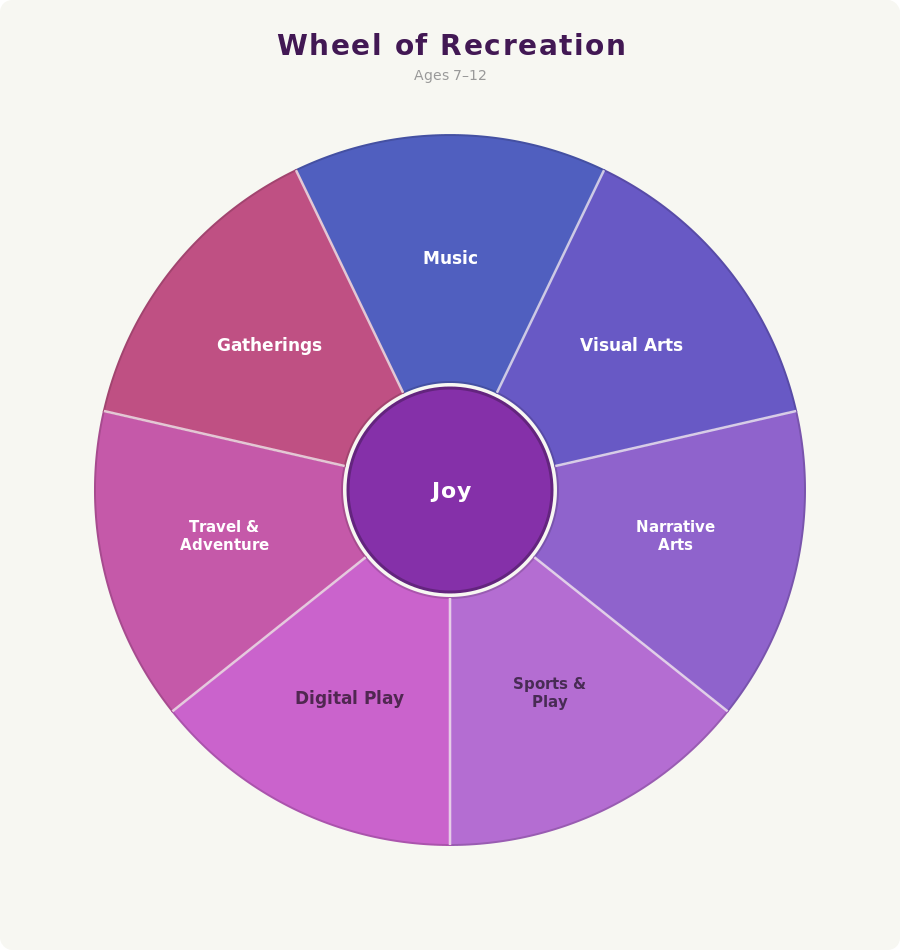
Recreation — Music, art, stories, sports, games, travel, gatherings. The center of Recreation is Joy — not distraction or entertainment, but genuine delight in being alive.
How to Read Your Wheel
Here is the most important thing about the Wheel: it is not about being perfect in every area. It is about seeing clearly.
Ask yourself: which pillars are strong for me right now? Which ones are weak? Which ones have I been ignoring?
Most kids your age are naturally strong in Recreation and Nature, moderate in Learning, and weaker in Service and Matter. That is completely normal — you are not supposed to have a perfectly balanced Wheel at age ten. But you are supposed to notice where the gaps are and slowly, over time, fill them in.
Try this once a week: look at each pillar and honestly rate it — strong, okay, or needs attention. No judgment. Just observation. Over time, you will start to see patterns.
The Sub-Wheels
Here is something remarkable about the Wheel: each pillar has its own wheel inside it. This means you can zoom in. If a pillar feels weak, the sub-wheel tells you exactly where to look. “I’m unhealthy” is vague — “My sleep has collapsed and I’m not drinking enough water” is a diagnosis.
Health (center: Monitor) — Sleep, Recovery, Supplementation, Hydration, Purification, Nutrition, Movement.
Presence (center: Meditation) — Breath, Sound & Silence, Life Force, Intention, Reflection, Virtue, Entheogens.
Matter (center: Stewardship) — Home, Transport, Clothing, Technology, Finance, Provisioning, Security.
Service (center: Dharma) — Vocation, Value Creation, Leadership, Collaboration, Ethics, Systems, Communication.
Relationships (center: Love) — Couple, Parenting, Elders, Friendship, Community, Serving Others, Communication.
Learning (center: Wisdom) — Philosophy, Practical Skills, Healing Arts, Warrior Path, Languages, Digital Arts, Science.
Nature (center: Reverence) — Gardens & Trees, Immersion, Water, Earth & Soil, Air & Sky, Animals, Ecology.
Recreation (center: Joy) — Music, Visual Arts, Narrative Arts, Sports, Games & Play, Travel, Gatherings.
The Secret of the Wheel
Activities can serve many pillars at once. Swimming in a lake with your family on a weekend is Health (movement) + Nature (water, outdoors) + Relationships (family time) + Recreation (play) + Presence (if you are really there, feeling the water, hearing the birds). The Wheel does not ask you to do eight separate things every day. It asks you to be aware of all eight dimensions and to notice when one has been neglected too long.
The people who live the most complete, most alive lives are not the ones who score perfectly on every pillar. They are the ones who see clearly, adjust wisely, and keep all seven petals open to the sun.
Download
Download the Explorers Wheel as a printable PDF
See Also
- Wheel for Roots — the earliest developmental version (ages 0–3)
- Wheel of Harmony — the full adult presentation
- Wheel for Seedlings — the previous developmental version (ages 3–6)
- Wheel for Apprentices — the next developmental version (ages 13–17)
- Harmonic Pedagogy — the philosophical foundation
- Using the Wheel of Harmony — how to read and navigate the Wheel
Part of Harmonism‘s pedagogical series. Wheel images are in Media/wheels/children/explorers-7-to-12/.