The Wheel of Life — Seedlings Edition (Ages 3–6)
The Wheel of Life — Seedlings Edition (Ages 3–6)
A guide for parents and young children, based on the Wheel of Harmony.
For Parents & Educators
Why Introduce the Wheel at This Age?
Children between three and six are not conceptual thinkers — they are sensory beings. They learn through rhythm, repetition, story, and embodied experience. Introducing the Wheel of Harmony at this stage is not about teaching a philosophical framework. It is about planting the pattern.
The seven domains of the Wheel correspond to seven kinds of goodness that a young child already experiences: moving their body, eating nourishing food, playing with friends, exploring nature, making music, helping someone, and being quiet inside. These are not abstractions for a child — they are the texture of a good day. The Wheel gives them (and you) a shared language for naming what already matters.
What You Are Not Doing
You are not teaching Harmonism. You are not explaining Presence, Dharma, or the heptagonal structure. You are not introducing vocabulary that requires philosophical context to understand. A five-year-old who has never heard the word “Presence” but who can sit still for thirty seconds and notice how it feels — that child has more Presence than most adults who can define it.
The developmental stage here is early Beginner (Śiṣya) — guided immersion. The child needs structure, safety, rhythm, and clear models. Autonomy is premature. Freedom within structure is the operative principle: you provide the environment, the rituals, the language; the child explores within that container.
The Two Centers: Your Presence, Your Love
The quality of everything that follows — every practice, every check-in, every moment of naming — depends on two things that are prior to method. First: your Presence. The center of the Wheel of Harmony is the center of education itself. A parent who is fully here — calm, attentive, unhurried — transmits something beyond any curriculum. The child’s nervous system reads your state of being before processing a word you say. Second: your Love. Education is a relationship, and the center of the Wheel of Relationships is Love — not sentiment but the active practice of caring deeply and acting on that care. A child who feels genuinely loved and safe is neurologically capable of learning at full capacity. A child who does not is not — regardless of how rich the sensory environment or how wise the pedagogical design. These are not soft aspirations. They are the architectural preconditions of everything that follows. See Harmonic Pedagogy for the full philosophical grounding.
How to Use the Seedlings Wheel
As a daily check-in. At bedtime or breakfast, point to the flower wheel and ask: “What kind of goodness did you have today?” Did they play outside (Nature)? Help someone (Helping)? Move their body (Strong Body)? Eat something good (Strong Body)? Draw or sing (Play)? Be quiet for a moment (Being Still)? The goal is noticing, not scoring.
As a weekly rhythm. Each day of the week can loosely correspond to a petal — not rigidly, but as a gentle orientation. Monday might emphasize “Strong Body” (movement, healthy food focus), Tuesday “Nature” (outdoor time), Wednesday “Discovering” (a learning activity), and so on. The child absorbs the pattern without needing to articulate it.
As a storytelling frame. When reading stories or watching films, you can name what the characters are doing in Wheel terms: “The bear is helping his friend — that’s the ‘Helping’ petal.” “The girl went outside and felt the wind — that’s ‘Nature.’” This builds the category structure through narrative rather than instruction.
As a physical object. Print the flower wheel, laminate it, and put it on the wall. Let the child color a version. Make a craft version with seven fabric petals. The more sensory modalities the Wheel enters through, the deeper it roots.
What Each Petal Means (Parent Reference)
| Seedlings Name | Harmonism Pillar | What It Covers |
|---|---|---|
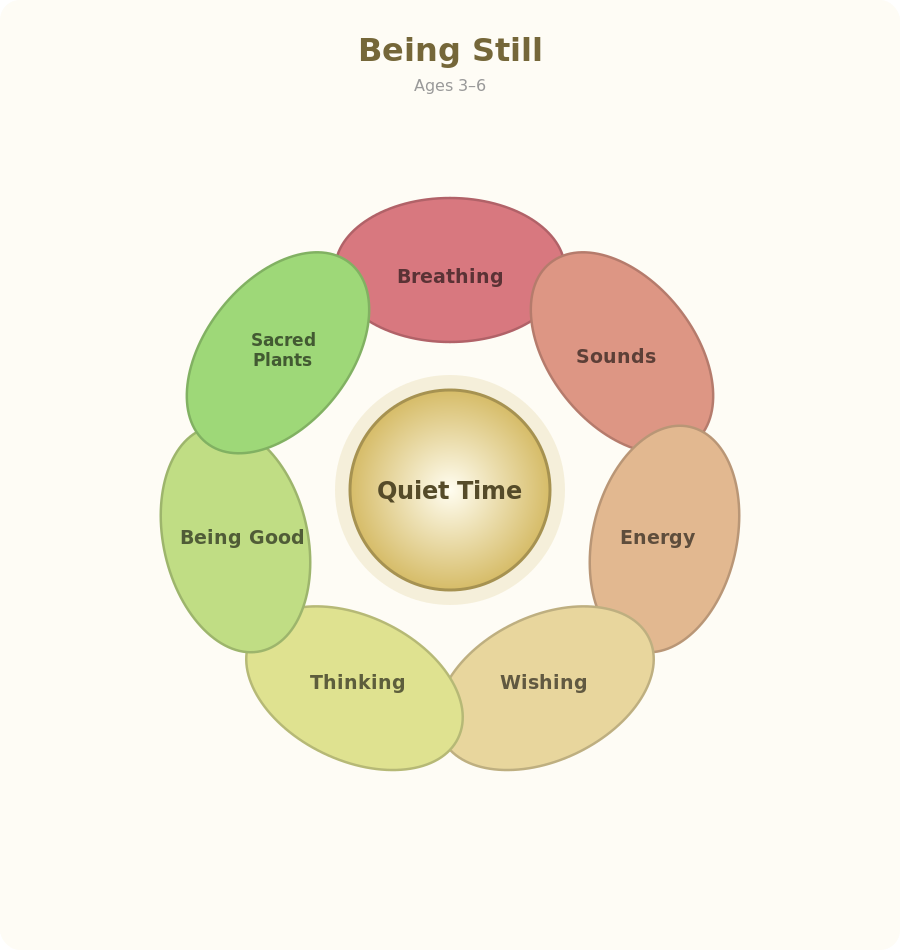
| Being Still | Presence | Quiet moments, breathing, noticing feelings, stillness before meals or sleep |
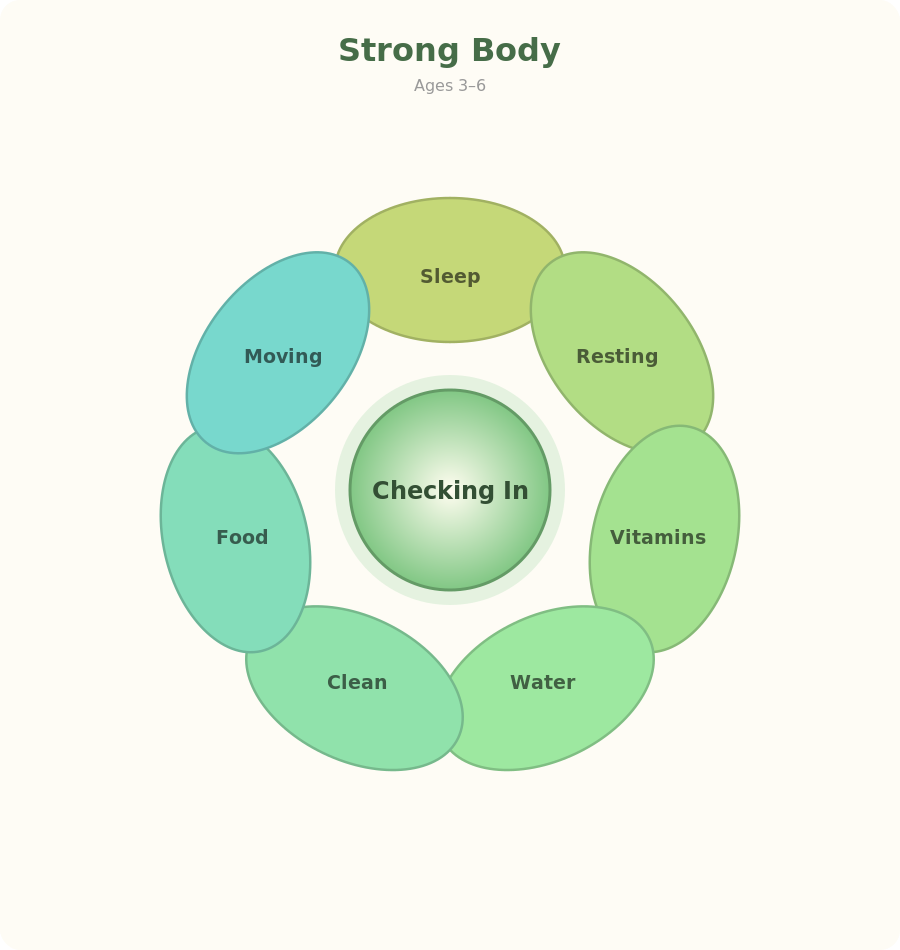
| Strong Body | Health | Sleep, food, water, movement, hygiene, rest |
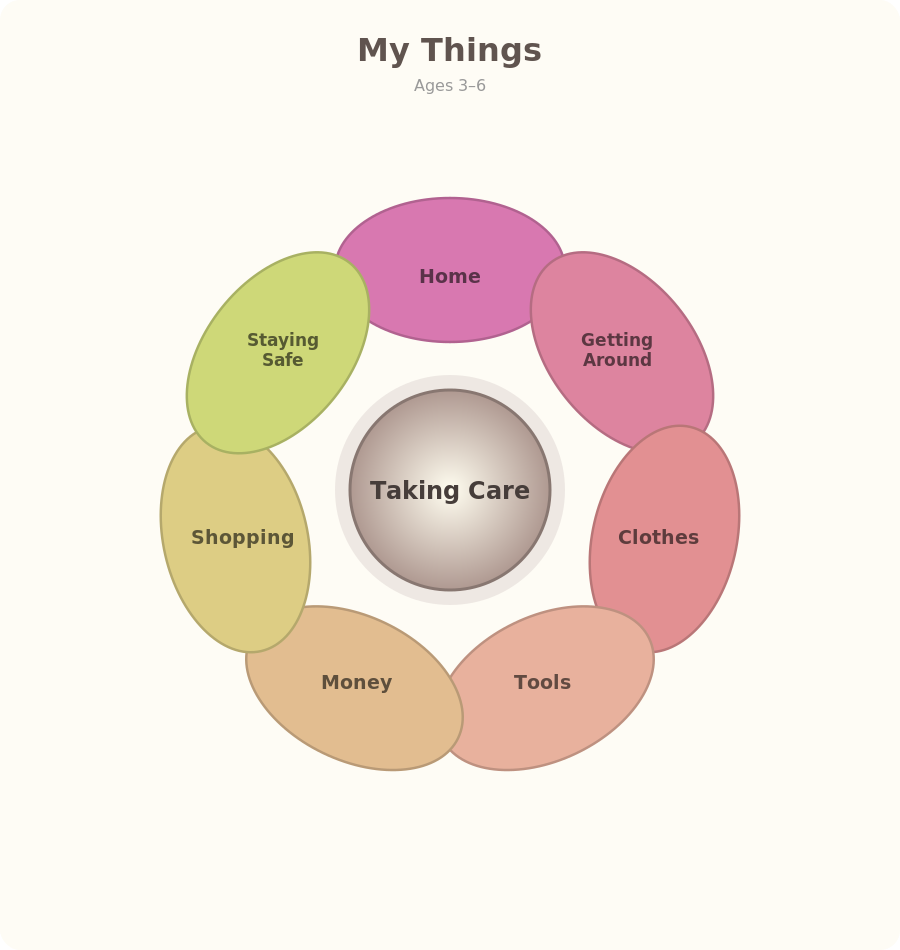
| My Things | Matter | Home, clothes, toys, tools, taking care of belongings |
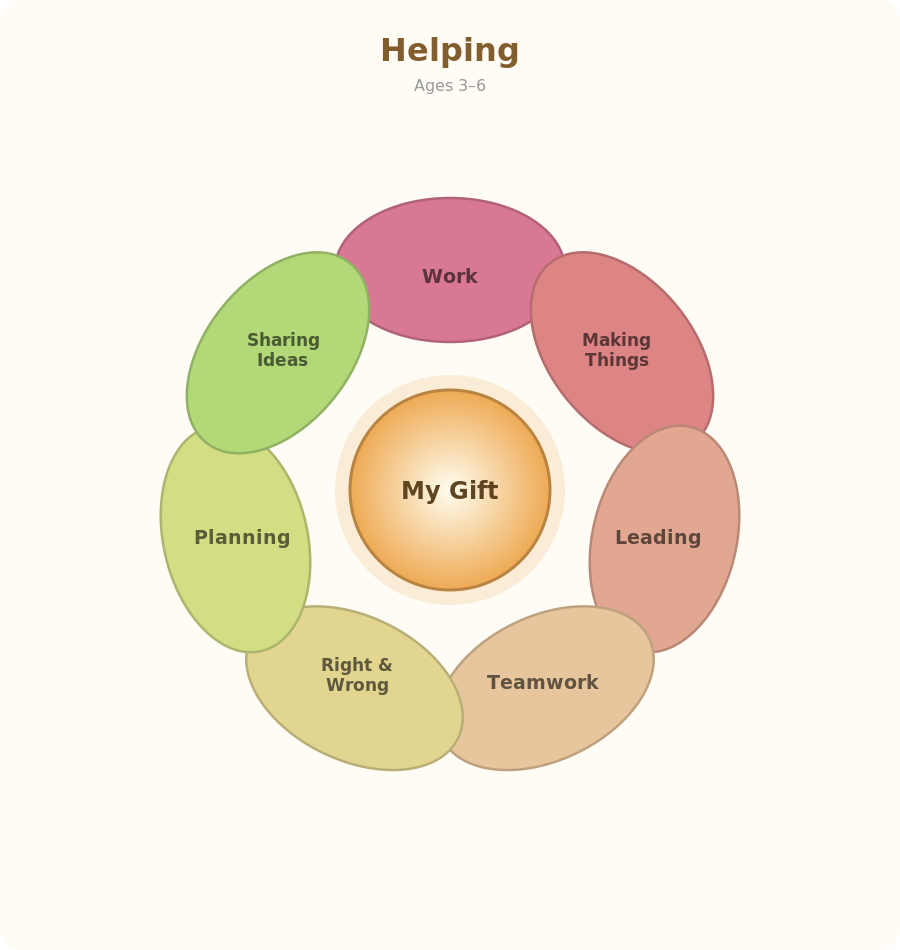
| Helping | Service | Chores, kindness, sharing, contributing to the household |
| People I Love | Relationships | Family, friends, grandparents, neighbors, communication |
| Discovering | Learning | Questions, stories, making things, language, nature observation |
| Nature | Nature | Outdoors, plants, animals, water, sky, soil, seasons |
| Play | Recreation | Music, art, stories, physical play, games, adventures |
The Sub-Wheels at This Age
Here is the main Wheel of Life — the flower your child will see:

Each main petal has its own little wheel with seven parts. You do not need to teach these to the child. They exist so that you, the parent, can diagnose what is missing. If your child’s “Strong Body” petal feels weak, the Health sub-wheel tells you where to look: Sleep? Water? Movement? Food? This is your diagnostic tool, not the child’s curriculum.
Being Still (Presence → Meditation):
Strong Body (Health → Monitor):
My Things (Matter → Stewardship):
Helping (Service → Dharma):
People I Love (Relationships → Love):

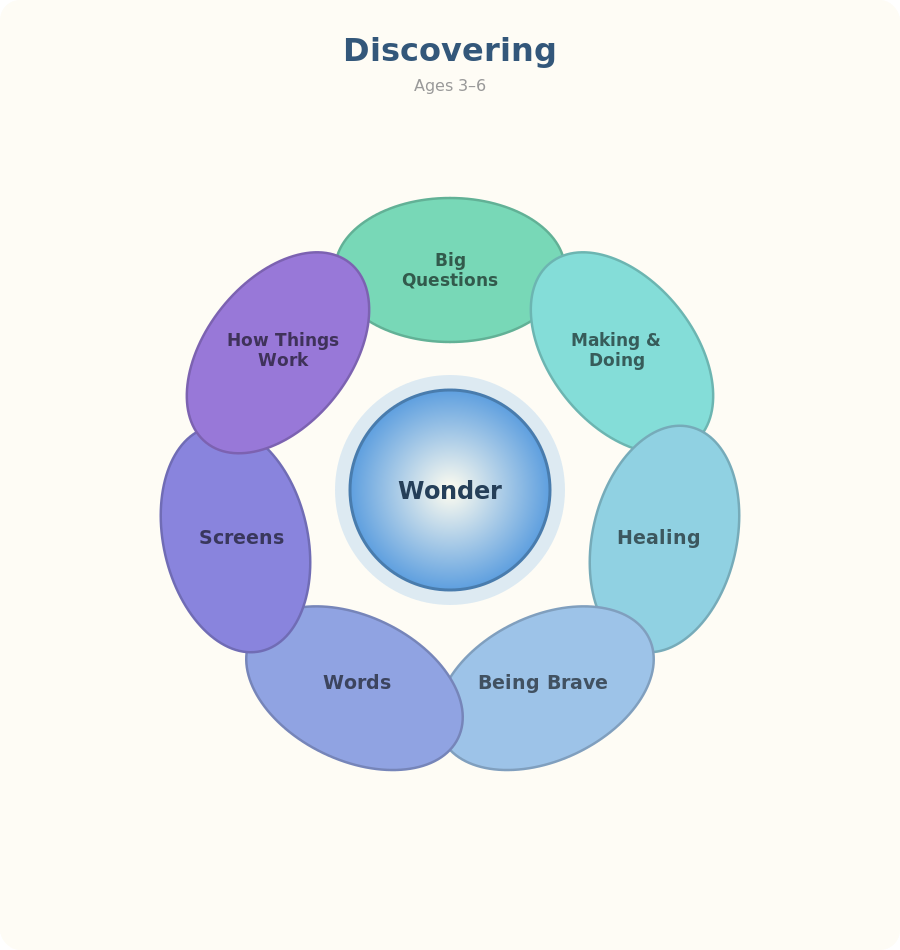
Discovering (Learning → Wisdom):
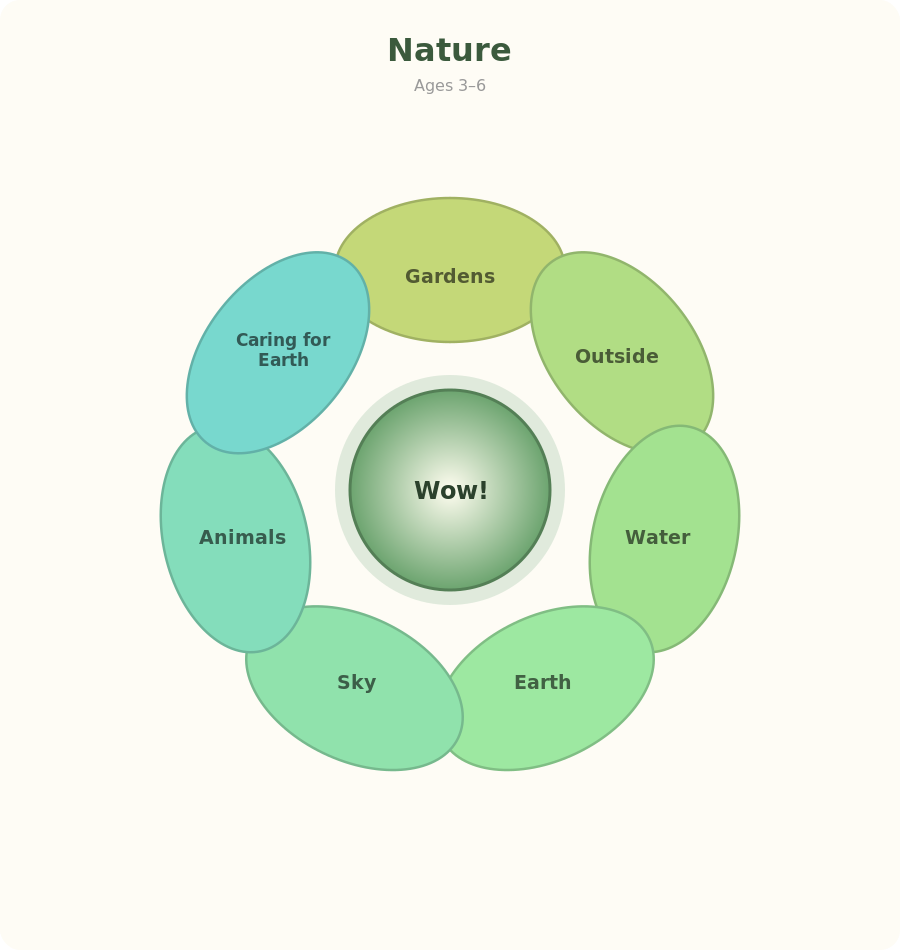
Nature (Nature → Reverence):
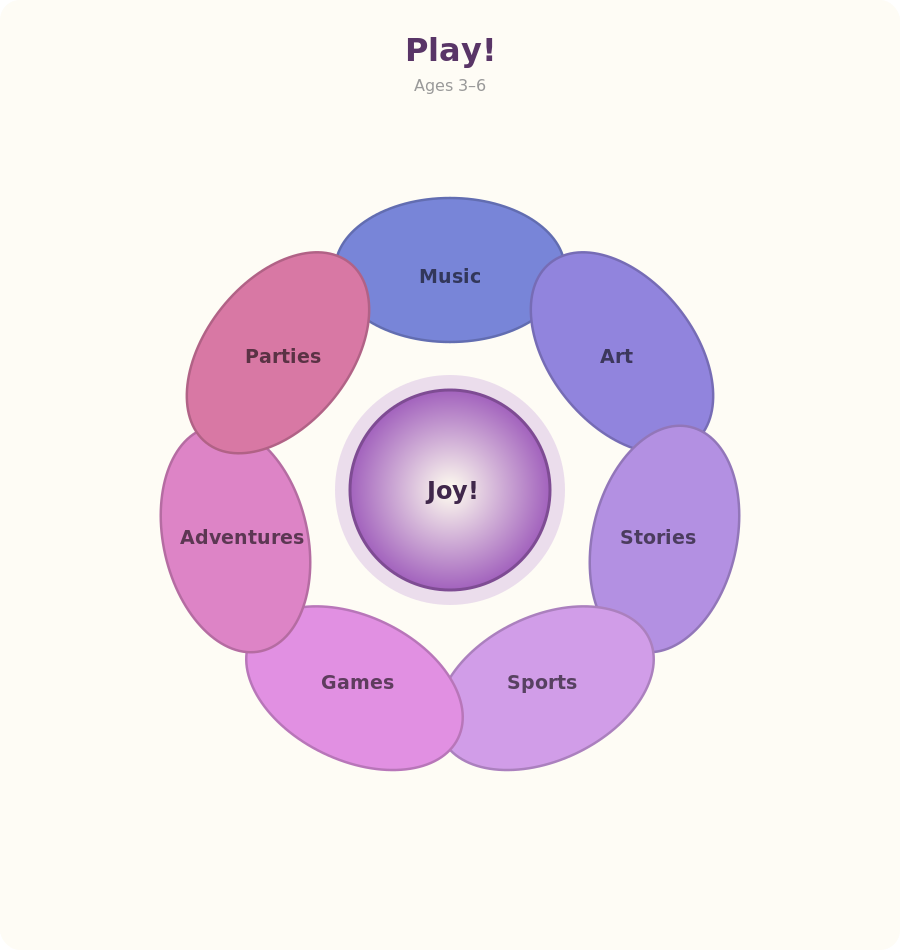
Play (Recreation → Joy):
Developmental Markers
By the end of this stage, a child who has been gently exposed to the Seedlings Wheel should be able to:
- Name the seven petals (in their simple language) without looking at the image
- Notice when they have had “too much of one kind” and “not enough of another” (early self-diagnosis)
- Sit in stillness for 30–60 seconds with some comfort (early Presence practice)
- Show curiosity about why the flower has a center and petals (readiness for the next stage)
For the Child
Your Wheel of Life
You know how a flower has petals? Your life is like a flower too. It has seven petals, and each petal is a different kind of goodness.
Being Still — Sometimes you close your eyes, breathe slowly, and just listen. That quiet feeling inside? That is the center of your flower. Everything else grows from it.
Strong Body — Sleeping well, drinking water, eating good food, running and climbing and moving. Your body is your home — taking care of it is one of the best things you can do.
My Things — Your room, your clothes, your toys, your favorite cup. Taking care of what you have is a way of saying thank you for it.
Helping — When you set the table, share your snack, or comfort a friend who is sad, you are using the “Helping” petal. It feels good because it is good.
People I Love — Mama, Papa, brothers, sisters, grandparents, friends, neighbors. The people around you are a treasure. Talking to them, listening to them, and being kind to them makes this petal glow.
Discovering — Asking “why?”, reading books, making things with your hands, learning new words, figuring out how something works. Your mind loves to discover. Let it.
Nature — Trees, birds, water, dirt, sky, bugs, flowers. The world outside is alive and it is your friend. Go outside. Look closely. Touch gently.
Play — Music, drawing, stories, sports, games, dancing, adventures. Playing is not wasting time — it is one of the most important things you do.
The Secret of the Flower
Every petal needs sunlight. If you only play but never rest, you get tired. If you only stay inside but never go out, you miss the trees. If you only discover but never help, something feels empty.
The secret is: a little of everything, every day. That is how the flower grows.
Download
Download the Seedlings Wheel as a printable PDF
See Also
- Wheel for Roots — the previous developmental version (ages 0–3)
- Wheel of Harmony — the full adult presentation
- Wheel for Explorers — the next developmental version (ages 7–12)
- Harmonic Pedagogy — the philosophical foundation
- Using the Wheel of Harmony — how to read and navigate the Wheel
Part of Harmonism‘s pedagogical series. Wheel images are in Media/wheels/children/seedlings-3-to-6/.