The Wheel of Harmony — Apprentices Edition (Ages 13–17)
The Wheel of Harmony — Apprentices Edition (Ages 13–17)
A guide for parents and adolescent learners, based on the Wheel of Harmony.
For Parents & Educators
The Adolescent Threshold
Between thirteen and seventeen, the learner crosses into what Harmonic Pedagogy calls the Intermediate (Sādhaka) to Advanced (Ācārya)-in-training transition. The defining feature of this stage is the emergence of genuine systems thinking: the capacity to hold multiple perspectives simultaneously, to reason about structures rather than just contents, and to ask the question that no younger child asks with full seriousness — what is the purpose of my life?
This is the age at which the Wheel shifts from a diagnostic tool to an existential framework. The adolescent does not merely check in on their pillars; they begin to understand why the Wheel has the structure it does, what it means that Presence sits at the center, and how the concept of Dharma — unique alignment with cosmic order — applies to their own emerging identity.
What Changes from the Explorers Version
The full Harmonism terminology is now available. Sub-wheels open completely, with all center principles named and their philosophical meaning accessible. The three epistemological registers become relevant: the adolescent can understand that there are different kinds of knowing (sensory, rational, experiential, contemplative), not just different amounts of information. The heptagonal geometry is not decorative — it carries philosophical weight (seven irreducible dimensions, each necessary, none redundant, Presence threading through all).
The Apprentice version also introduces the Architecture of Harmony — the civilizational counterpart to the personal Wheel. The adolescent who has spent years navigating their own Wheel is ready to see how the same pattern scales: Nourishment corresponds to Health, Governance to Service, Community to Relationships, Education to Learning, Ecology to Nature, Culture to Recreation, Stewardship to Matter, and Dharma at center corresponds to Presence. This connection between the personal and the civilizational is one of the most powerful moves in Harmonism, and the adolescent mind is developmentally prepared to receive it.
How to Support Without Imposing
The adolescent’s relationship to the Wheel must be sovereign. If the Wheel becomes something their parents make them do, it is dead. The entire architecture of Harmonist pedagogy is self-liquidating by design: you teach the person to read and navigate the Wheel themselves, then step back. Success means they no longer need you. This is Harmonics in its pedagogical expression — the practitioner transmits the discipline of reading the Wheel, not dependence on the practitioner’s reading of it.
This means: make the Apprentice Wheel available. Discuss it when the adolescent initiates. Model its use in your own life — let them see you doing your own Wheel check-in, naming your own imbalances, making your own adjustments. But do not require Wheel journaling, do not grade their self-assessments, and do not weaponize the framework against them (“Your Service pillar is low — you should do more chores”). The moment the Wheel becomes a compliance instrument, it loses everything that makes it valuable.
The exception is genuine crisis. If an adolescent is clearly neglecting Health (sleep collapse, nutritional dysfunction), Relationships (complete isolation), or Presence (inability to be still for even a moment, chronic screen dependency), then the parent’s duty is to name what they see — using the Wheel’s language — and intervene. But this is parental discernment, not pedagogical method.
The Dual Center at This Stage
Harmonism’s two deepest educational commitments — Presence as the educator’s state of being and Love as the center of every educational relationship — converge here with particular force, precisely because the temptation to abandon them is strongest during adolescence. The adolescent pushes back. They test boundaries. They reject what they previously accepted. The parent who loses Presence in the face of this — who reacts from fear, control, or wounded authority — transmits exactly the fragmentation they are trying to prevent. The parent who loses Love — who withdraws care as punishment for the adolescent’s increasing independence — destroys the relational foundation that makes the Wheel usable.
What the adolescent needs from the parent at this stage is the highest expression of both centers simultaneously: the clarity of Presence (seeing the adolescent accurately, without projection or sentimentality) joined with the warmth of Love (holding the adolescent’s development as genuinely important, even — especially — when the adolescent is making it difficult). This is the Ajna–Anahata axis in its most demanding application. The self-liquidating guidance model is the logical expression of this dual center: the educator who loves the adolescent’s sovereignty more than the adolescent’s dependence, who sees clearly enough to know when continued guidance would become obstruction. Stepping back is not detachment. It is the highest form of Love informed by Presence.
Sensitive Content at This Stage
Two Wheel elements require explicit parental awareness at this age:
Entheogens (Presence sub-wheel, 7th pillar). Harmonism positions entheogens as sacred plant medicine — not recreational substances. The adolescent should understand Harmonism framing: these are powerful tools for consciousness expansion that have been used with reverence, preparation, guidance, and integration across traditions worldwide. They are never used casually, never used alone, and never used before the psyche has sufficient grounding (which, in Harmonism terms, means a stable Presence practice and emotional maturity). The honest position is that premature or irresponsible use is genuinely dangerous, while dismissing the entire domain as “drugs” is intellectually dishonest and leaves the adolescent without a coherent framework when they inevitably encounter the question.
Gender & Initiation (Learning sub-wheel, 4th pillar). This addresses the archetypal dimension of becoming an adult — the rites of passage, the warrior path, the cultivation of gendered strength and virtue that traditional societies encoded in initiation practices. Harmonism holds that masculinity and femininity are real archetypal structures (not merely social constructions), and that adolescents benefit from conscious engagement with these archetypes as they mature. This is a domain where Harmonism’s position differs from mainstream progressive pedagogy. Present it with philosophical seriousness, not as ideology.
Developmental Markers
By the end of this stage, the adolescent should be able to:
- Navigate the full 7+1 Wheel structure at both master and sub-wheel levels
- Articulate what each center principle means (Meditation, Monitor, Stewardship, Dharma, Love, Wisdom, Reverence, Joy) and why it occupies the center of its wheel
- Conduct a detailed self-assessment identifying specific sub-wheel categories that need attention
- Understand the relationship between the personal Wheel and the civilizational Architecture
- Sit in meditation for 15–20 minutes with reasonable stability
- Articulate their emerging sense of Dharma — what they care about, what they are drawn to, what they feel called to do — even if it is still forming
- Engage with the philosophical foundations of Harmonism (metaphysics, epistemology, ethics) at an introductory level
For the Apprentice
The Architecture of a Complete Life
You have used the Wheel of Harmony before — perhaps as a child’s flower, perhaps as a seven-part map. Now it is time to see it as what it truly is: a philosophical architecture for navigating every dimension of a human life.
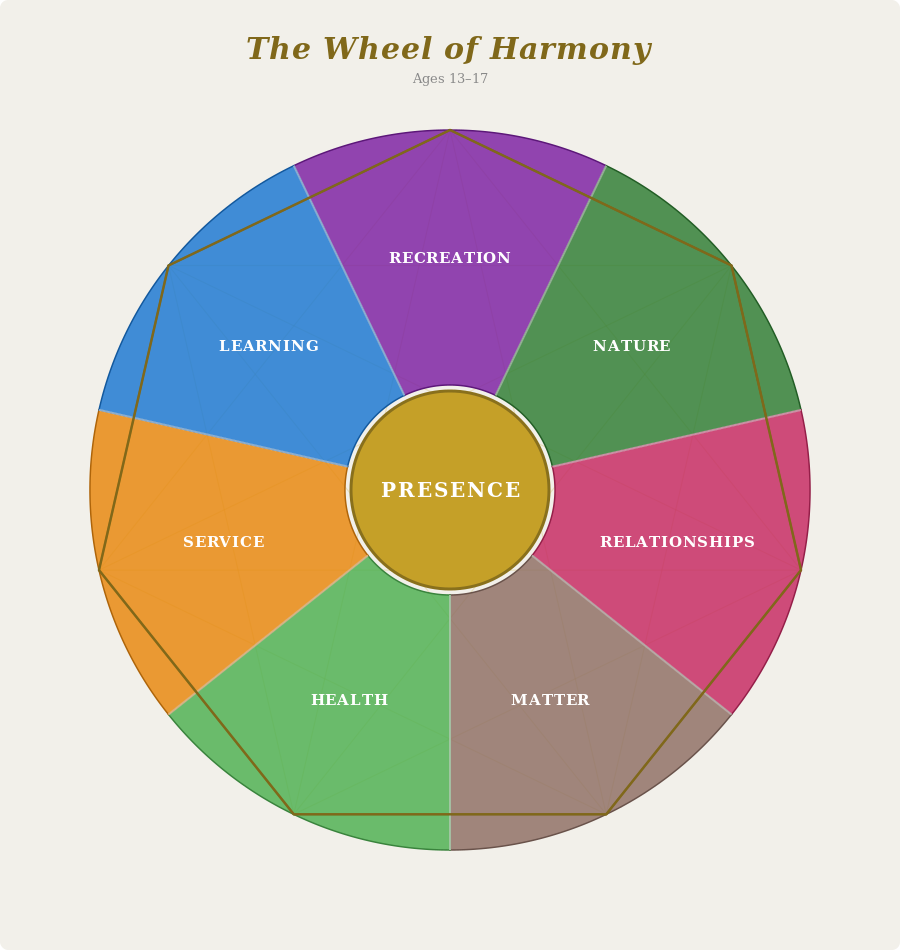
The Wheel is a heptagon — a seven-sided figure — with Presence at its center and seven peripheral pillars. This is not an arbitrary arrangement. Each pillar represents an irreducible dimension of human existence aligned with Logos, the inherent harmonic intelligence of the cosmos. Remove any one of them and the life is structurally incomplete. Add an eighth and you will find it already lives inside one of the seven.
The seven peripheral pillars are: Health, Matter, Service, Relationships, Learning, Nature, and Recreation. They are ontologically co-equal among themselves (no peripheral pillar is more important than another in principle) but operationally asymmetric (your life phase, your temperament, and your Dharma determine which pillars demand the most energy at any given time).
Presence is the central pillar — fractally most important, present at the centre of every peripheral pillar as that pillar’s own central principle. It is the awareness, the quality of attention, the capacity to be fully here in whatever you are doing. A workout performed with Presence is qualitatively different from the same workout performed on autopilot. A conversation held with Presence is a different event from the same words spoken while distracted. Presence is the difference between living and merely functioning.
The Center Principles
Each pillar has its own internal wheel — a sub-wheel with seven categories and a center principle. The center principle is the essence of that domain, the thing that orients everything else within it:
Presence → Meditation. The practice of directing awareness inward. Not relaxation, not stress relief, not mindfulness-as-productivity-hack. Meditation is the systematic cultivation of the capacity to perceive reality without distortion — to see what is, rather than what you wish or fear.
Health → Monitor. The practice of paying attention to your body’s signals — sleep quality, energy levels, digestion, recovery, mood. Health is not about following rules; it is about reading your own instrument panel and responding to what it shows.
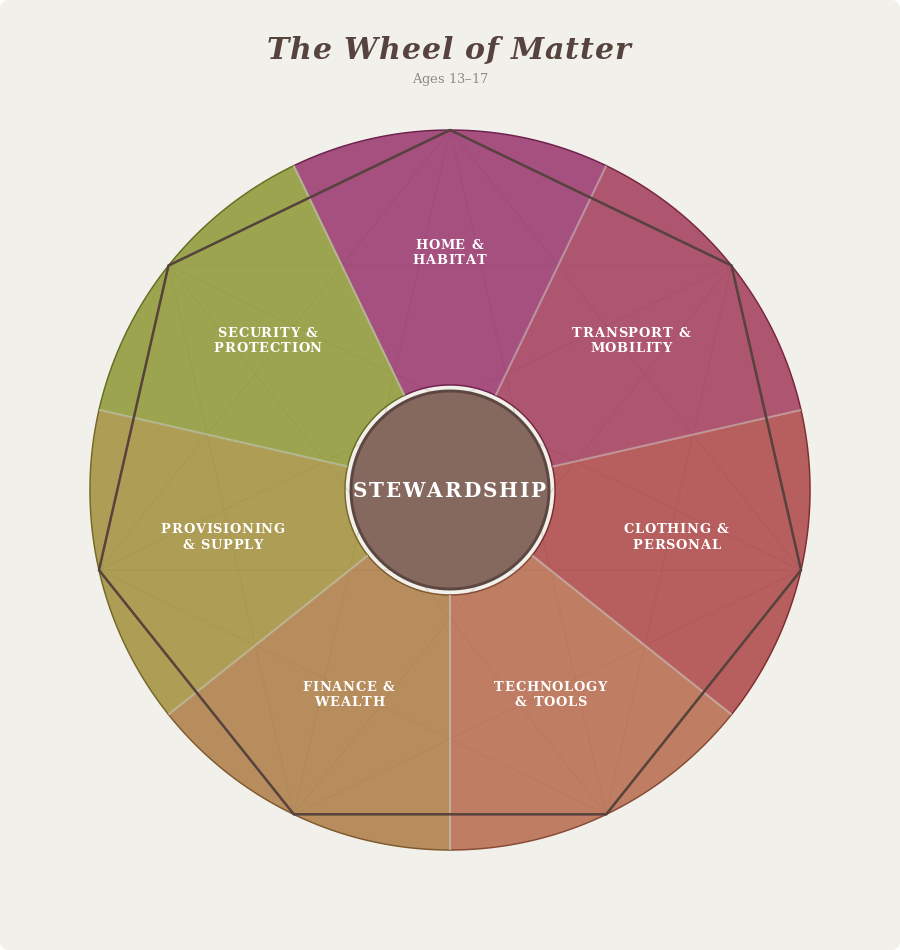
Matter → Stewardship. The governing orientation toward the physical world is not consumption but care. Your home, your tools, your finances, your possessions — these are not just things you have but things you are responsible for. Stewardship means leaving the material world better than you found it.
Service → Dharma. The deepest question the Wheel asks: what are you here to do? Not your job, not your hobby — your calling. The thing that aligns your unique capacities with what the world actually needs. Finding Dharma is the work of a lifetime, and it begins now, in adolescence, with the question itself.
Relationships → Love. Not the romantic feeling (though that is included) but the active practice of caring deeply about other beings and acting on that care. Love as a discipline — showing up, listening, being honest, forgiving, protecting, sacrificing when necessary.
Learning → Wisdom. The difference between knowledge and wisdom is the difference between knowing facts and understanding what they mean. Wisdom is knowledge integrated into lived understanding — the capacity to see the pattern behind the details and to act from that seeing.
Nature → Reverence. The natural world is not a backdrop for human activity. It is a living system of which you are a part. Reverence means approaching nature as a participant, not a tourist — with attention, care, and humility.
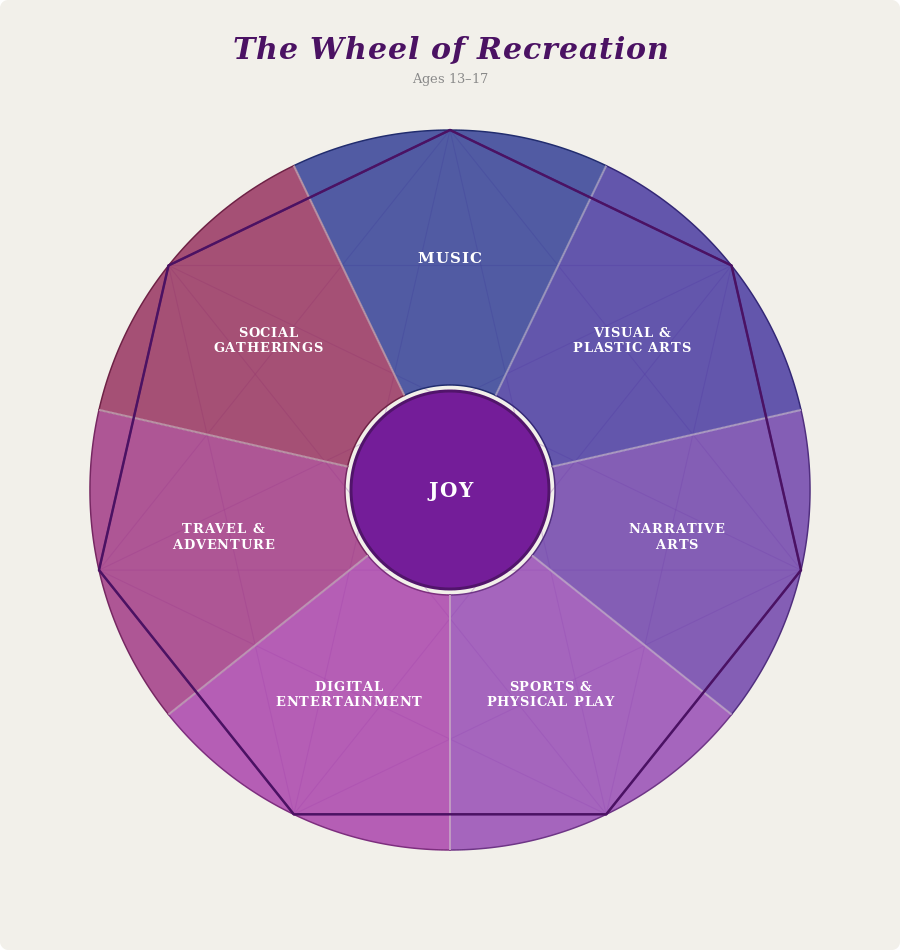
Recreation → Joy. Not entertainment, not distraction, not the consumption of stimulation. Joy is the natural state of a human being who is engaged with life fully. Music, art, stories, sports, travel, and gathering with others are not optional extras — they are essential expressions of being alive.
The Sub-Wheels
Each pillar opens into its own seven-part wheel. Here is the full map:
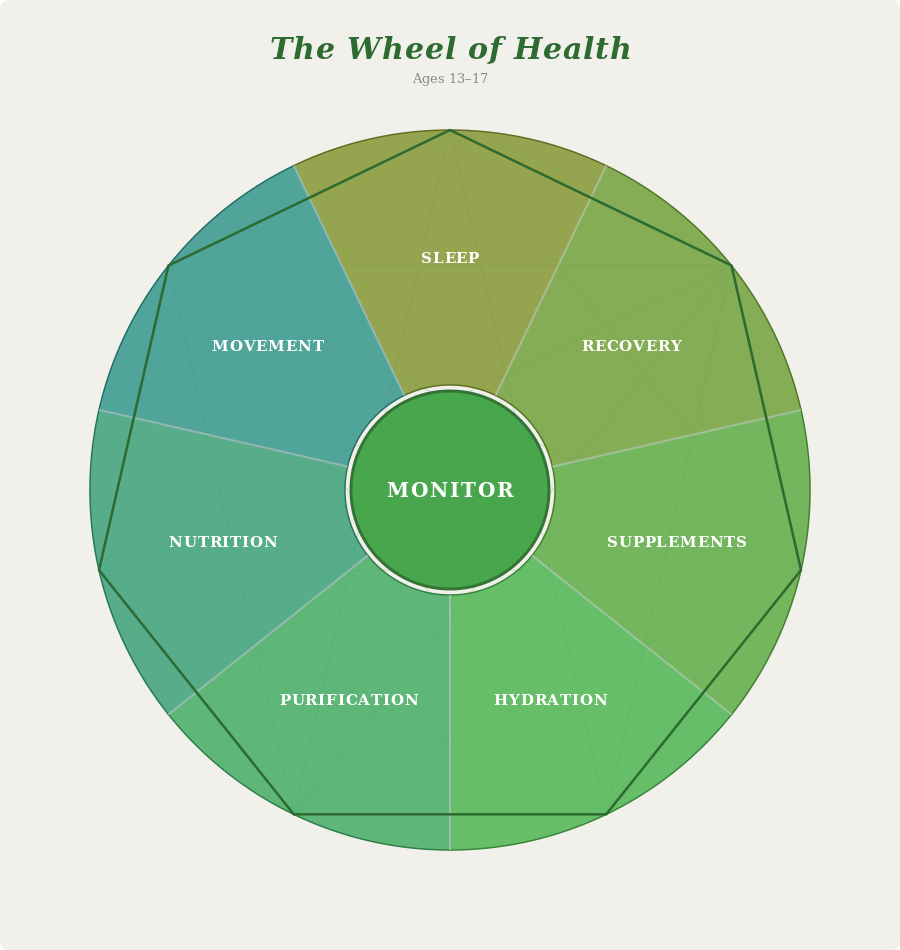
The Wheel of Health (center: Monitor): Sleep, Recovery, Supplementation, Hydration, Purification, Nutrition, Movement. When your Health pillar feels off, this sub-wheel tells you exactly where to look. Are you sleeping enough? Drinking enough water? Moving your body? The precision matters — “I’m unhealthy” is a complaint; “My sleep has collapsed and my hydration is inadequate” is a diagnosis.
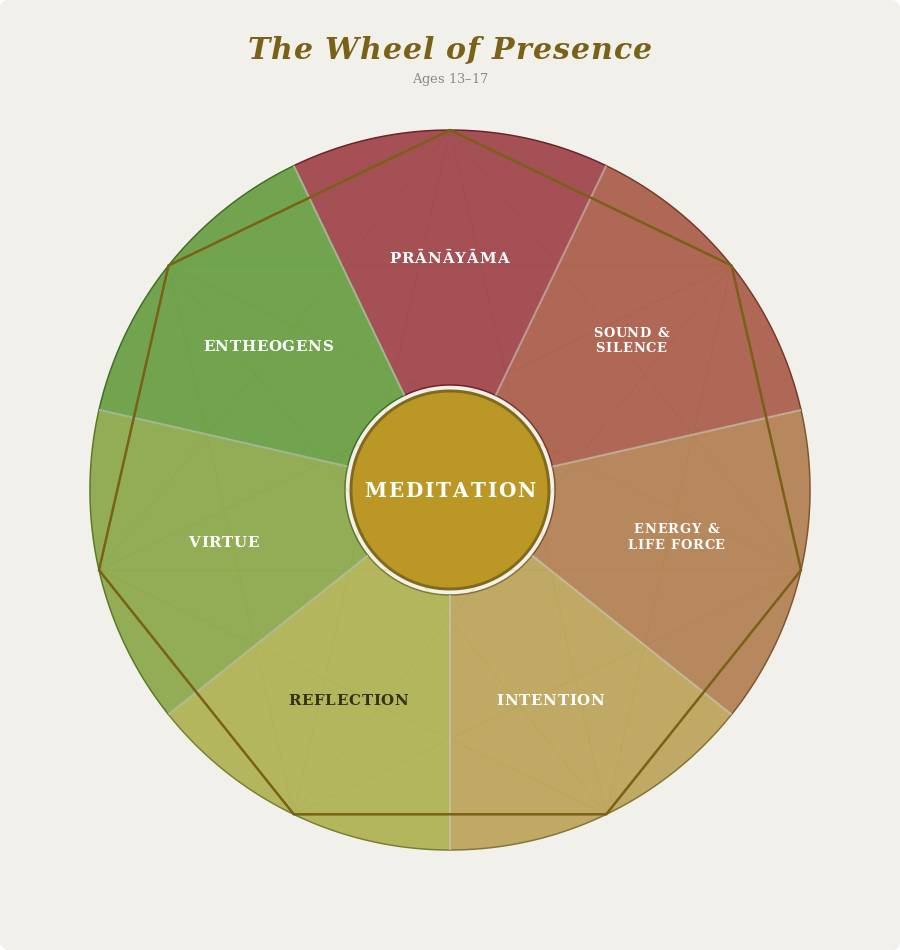
The Wheel of Presence (center: Meditation): Prāṇāyāma (breath practices), Sound & Silence, Energy & Life Force, Intention, Reflection, Virtue, Entheogens. Notice that Breath lives here, not in Health — this is a key architectural decision in Harmonism. Breathing as an autonomic function is Health; breathing as a gateway to altered states of consciousness is Presence.
The Wheel of Matter (center: Stewardship): Home & Habitat, Transportation & Mobility, Clothing & Personal Items, Technology & Tools, Finance & Wealth, Provisioning & Supply, Security & Protection. The material dimension of your life is not superficial — how you relate to your possessions, your space, and your resources reveals your relationship with responsibility itself.
The Wheel of Service (center: Dharma): Vocation, Value Creation, Leadership, Collaboration, Ethics & Accountability, Systems & Operations, Communication & Influence. This is the wheel that asks the hardest question: what are you here to contribute? Dharma at center means that every form of service — from leadership to collaboration to communication — is oriented by your unique alignment with purpose.
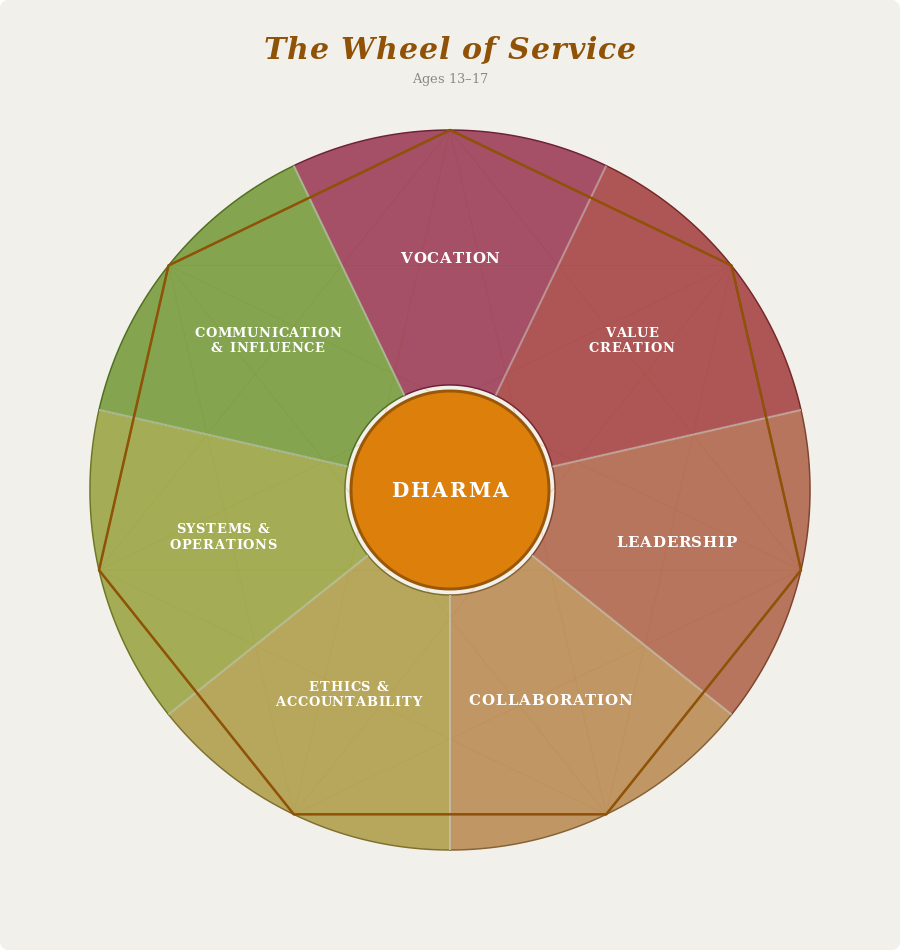
The Wheel of Relationships (center: Love): Couple, Parenting, Family Elders, Friendship, Community, Service to Vulnerable, Communication. Every relationship you have — from the most intimate to the broadest communal — is held by the same center principle. Love is not a feeling you fall into; it is a practice you build.
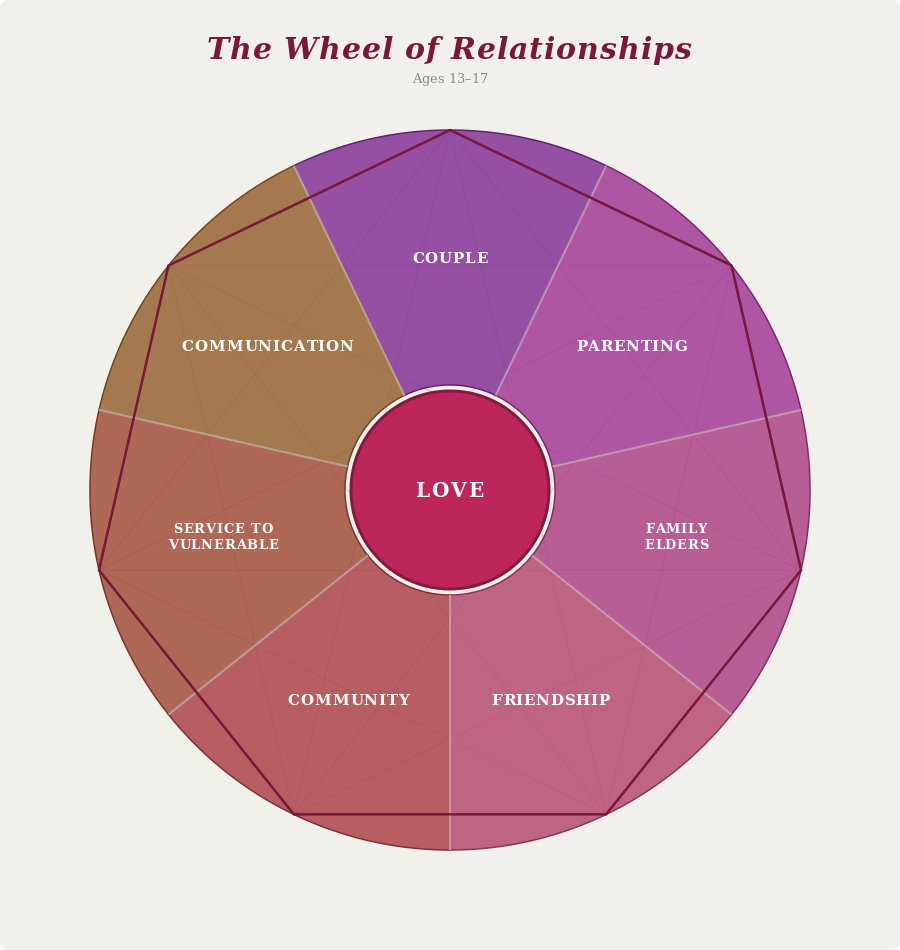
The Wheel of Learning (center: Wisdom): Philosophy & Sacred Knowledge, Practical Skills, Healing Arts, Gender & Initiation, Communication & Language, Digital Arts, Science & Systems. Learning is not school — it is the lifelong process of deepening your understanding of reality. Wisdom at center means that knowledge without integration is incomplete.
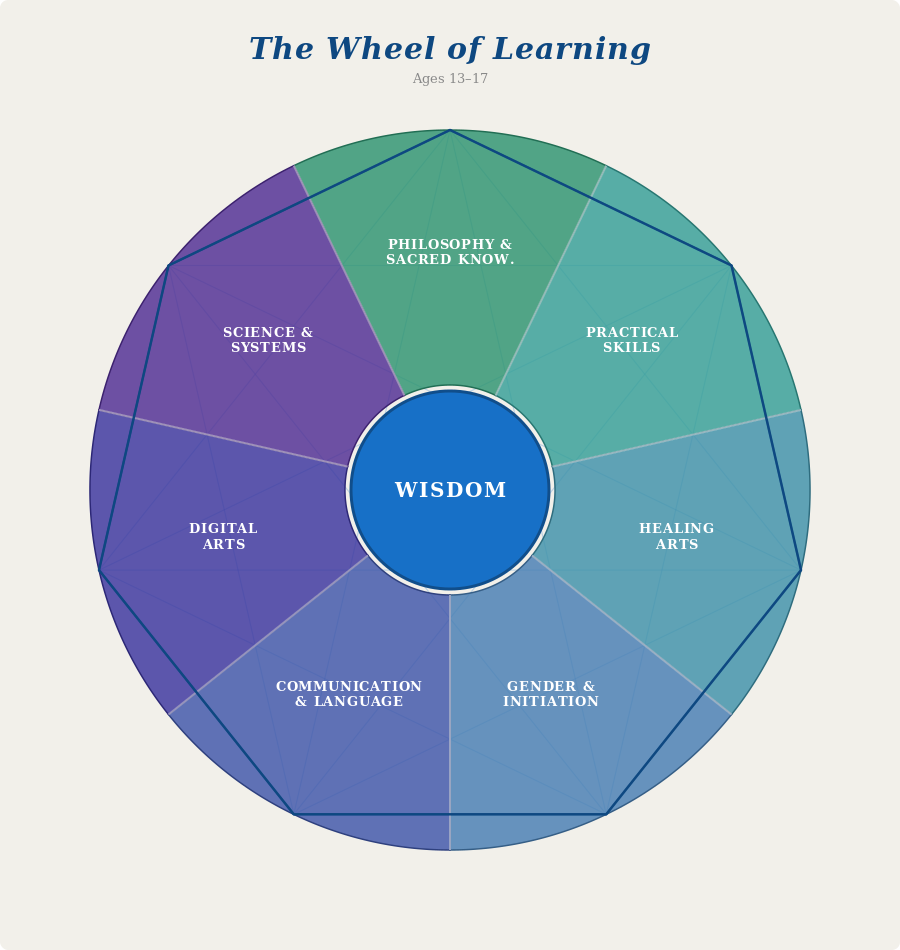
The Wheel of Nature (center: Reverence): Permaculture/Gardens/Trees, Nature Immersion, Water, Earth & Soil, Air & Sky, Animals & Wildlife, Ecology & Resilience. Your relationship with the natural world is not recreational — it is ontological. You are part of this system, not a visitor to it.
The Wheel of Recreation (center: Joy): Music, Visual & Plastic Arts, Narrative Arts, Sports & Physical Play, Games & Interactive Play, Travel & Adventure, Social Gatherings. Joy is not distraction. It is the natural expression of a life engaged with beauty, play, story, and shared celebration.
Why This Architecture?
You might ask: why seven? Why not five, or ten, or twelve? The answer is structural, not aesthetic. The Anatomy of the Wheel provides the rigorous derivation, but the essence is this: seven is the minimum number of irreducible dimensions needed to map a complete human life. Fewer than seven forces categories to merge that are genuinely distinct (Health and Nature, for instance, cannot be collapsed without losing diagnostic power). More than seven creates redundancy — any proposed eighth pillar turns out to be a sub-category of an existing one.
The 7+1 structure (seven peripheral pillars plus Presence at center) is fractal: it repeats at every level. Each sub-wheel has the same pattern. This means the Wheel is not a list to memorize but a pattern to recognize. Once you understand the logic at one level, you understand it at every level.
The Wheel and the Architecture
Here is something most people do not see until they are ready: the Wheel has a civilizational twin. The Architecture of Harmony maps the same seven dimensions at the scale of societies and institutions, not individuals. Health becomes Nourishment (public health, food systems, physical infrastructure). Service becomes Governance (political organization, justice, leadership). Learning becomes Education. Nature becomes Ecology. Recreation becomes Culture.
This means the same framework you use to navigate your personal life can also be used to understand — and eventually to shape — the world around you. The person who has spent years cultivating their own Wheel has, without knowing it, been building the perceptual apparatus to recognize what a healthy civilization looks like and where ours is failing.
Your Dharma
The deepest function of the Wheel is not diagnostic but orientational. It exists to help you find your Dharma — your unique alignment with what Harmonism calls Logos, the fundamental order of reality.
Dharma is not a career. It is not a passion project. It is the thing that emerges when your deepest capacities meet the world’s genuine needs — when what you are naturally drawn to and what you are unusually good at converge with what actually matters. Finding it is not an event but a process, and that process is what the Wheel supports: by keeping all eight dimensions of your life visible, it prevents you from getting so absorbed in one area that you lose sight of the whole.
You are at the beginning of this search. The fact that you are engaging with these ideas at all means the search has begun. Trust it. The Wheel is not a cage that constrains you — it is a compass that orients you. Where you go is your own.
Download
Download the Apprentices Wheel as a printable PDF
See Also
- Wheel for Roots — the earliest developmental version (ages 0–3)
- Wheel of Harmony — the full adult presentation
- Wheel for Explorers — the previous developmental version (ages 7–12)
- Using the Wheel of Harmony — how to read and navigate the Wheel
- Harmonic Pedagogy — the philosophical foundation
- Architecture of Harmony — the civilizational counterpart
- Anatomy of the Wheel — formal derivation and validation
Part of Harmonism‘s pedagogical series. Wheel images are in Media/wheels/children/apprentices-13-to-17/.