The Roots Wheel — A Parent's Guide (Ages 0–3)
The Roots Wheel — A Parent’s Guide (Ages 0–3)
Environmental design guide for the earliest years, based on the Wheel of Harmony.
Why the Wheel Begins at Birth
Harmonism holds that the child arrives as a multidimensional being — not a blank slate waiting to be inscribed, but a consciousness already possessing physical, vital-emotional, relational, communicative, perceptual, and intuitive capacities. The cross-traditional convergence is precise: Vedic tradition recognizes the child’s innate sahaja (natural awareness), Montessori names the “absorbent mind” of the first three years, and contemporary developmental neuroscience confirms that the 0–3 window is the period of greatest neuroplasticity in the entire human lifespan.
To start the Wheel at three would be to concede — against Harmonism’s own ontology — that the framework only activates once the child can conceptualize. But the child between zero and three is not pre-Wheel. They are living every domain of the Wheel through the body, the senses, and the relational field. What they lack is not engagement with reality but the capacity to name it. That capacity belongs to the parent.
The Roots Wheel is therefore not a version of the Wheel for children. It is the Wheel as an environmental design tool for parents — a diagnostic for whether the world you are building around your infant and toddler is whole.
What You Are Doing
You are auditing the environment. Seven domains, seven questions you ask not of the child but of the world you are constructing for them. The child does not see a diagram, hear a vocabulary, or participate in a check-in. They simply live inside the architecture you build. Your job is to make that architecture complete.
The developmental stage here is the earliest phase of the Beginner (Śiṣya) stage — entirely guided. The child has zero autonomy over their environment and depends completely on the adults around them for structure, safety, rhythm, and sensory richness. This is not a limitation to overcome. It is the design of this developmental moment: total immersion in a field created by others.
The Seven Domains
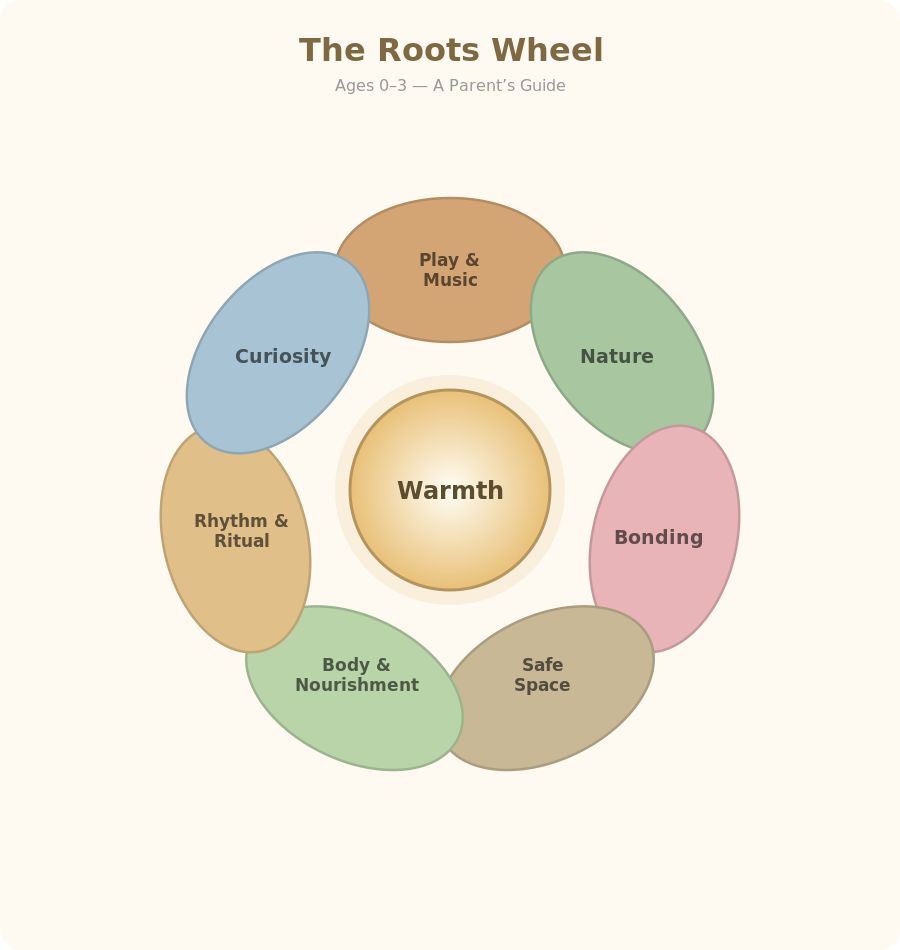
Warmth — The Center
The center of the Roots Wheel is not Presence (the child already has Presence — it is their default state) but Warmth: the quality of the relational field the parent provides. Warmth is Presence expressed through touch, tone, gaze, and rhythm. A warm environment is one where the child’s nervous system can regulate through co-regulation with the caregiver. A cold, chaotic, or emotionally volatile environment fragments the child’s capacity to settle into the natural state that Presence names.
Everything else in the Wheel depends on this center. If Warmth is absent, no amount of good nutrition, nature exposure, or sensory stimulation compensates.
Warmth thus encodes Harmonism’s two deepest educational commitments simultaneously. Presence — the center of the Wheel of Harmony — manifests here as the parent’s regulated state of being: the calm nervous system, the unhurried gaze, the quality of attention that the infant absorbs before they can understand a single word. Love — the center of the Wheel of Relationships — manifests here as the active practice of attunement, responsiveness, and care that builds the child’s secure attachment. The parent who cultivates both Presence and Love does not need a parenting manual. They have something more fundamental: a centered consciousness from which the right response arises naturally, moment by moment, calibrated to this child at this developmental threshold. At the deepest level, Harmonism holds that this is not merely behavioral. When the parent’s Ajna and Anahata are activated — when Presence is the luminous stillness of an awakened center and Love is the radiant warmth of an open heart — their energetic field becomes the infant’s learning environment. The child’s own subtle body entrains to this coherence through resonance, not instruction. This is why Warmth is irreplaceable: it is the material and energetic precondition for everything else in the Wheel.
Body & Nourishment
The physical foundation. This is the Wheel of Health translated into the 0–3 context:
Sleep. The infant’s primary activity. Sleep architecture in the first three years shapes neurological development, emotional regulation, and growth hormone cycling. Protect sleep ruthlessly: dark rooms, consistent rhythms, minimal disruption. Co-sleeping or separate sleeping is a family decision — the non-negotiable is that the child sleeps enough, safely, and with consistent patterns.
Nutrition. Breastfeeding is the gold standard — colostrum as first immune architecture, breast milk as the most complete food available. When breastfeeding isn’t possible, the quality of alternatives matters enormously. Introduction of solids follows the child’s readiness (typically 6+ months): whole foods, no processed sugar, no seed oils, no industrial formula if avoidable. The gut biome established in the first two years shapes immune function for life.
Touch & Movement. Skin-to-skin contact. Being carried, held, rocked. Tummy time. Floor time. Crawling. Walking. The child’s proprioceptive and vestibular systems develop through movement, not observation. Minimize containers (bouncers, walkers, car seats beyond transport necessity). Let the body do what it was designed to do.
Hydration. Clean water from the moment solids are introduced. The quality of water matters — see Hydration.
Safe Space
The Wheel of Matter at the earliest scale. The infant’s environment is their entire world. Audit it:
Order. A calm, uncluttered space reduces sensory overwhelm and supports the child’s emerging capacity to focus. This is Montessori’s “prepared environment” principle: everything in the child’s reach should be intentional, beautiful, and appropriately scaled.
Materials. Natural materials over plastic. Wood, fabric, metal — objects with sensory variety (texture, weight, temperature). The fewer toys, the deeper the engagement. Rotation over accumulation.
Safety. Non-toxic. No electromagnetic pollution in the sleep space. Clean air. Minimal screen exposure (zero before 18 months, per both WHO and Harmonist guidelines — not because screens are inherently evil but because the developing nervous system needs real sensory input, not compressed digital simulation).
Rhythm & Ritual
This is the Service domain refracted through infancy. The child cannot serve, but the child can participate in the rhythmic structure of household life — and this participation is the earliest form of contribution.
Daily rhythm. Wake, feed, play, rest — the same sequence, roughly the same times, day after day. Rhythm is the infant’s substitute for comprehension. They cannot understand why things happen, but they can feel when things happen. Predictability builds the neurological foundation for self-regulation.
Ritual. Bedtime sequences. Mealtime patterns. Songs that mark transitions. A prayer or moment of stillness before sleep. These are not arbitrary — they are the earliest architecture of Presence, experienced as structure before it can be experienced as awareness.
Participation. From twelve months onward, the toddler can participate in household activity: carrying objects, wiping surfaces, sorting laundry, watering plants. This is not play — it is genuine contribution at the scale available to them. Respect it as such.
Bonding
The Relationships domain at its most foundational. Attachment theory — from Bowlby through the contemporary neuroscience of co-regulation — confirms what every wisdom tradition knew: the quality of the primary bond shapes everything that follows. Secure attachment is the relational infrastructure on which all later relationships are built.
The primary bond. Mother, father, or primary caregiver — the person whose nervous system the infant’s nervous system learns to co-regulate with. Be present. Be consistent. Be warm. Respond to the child’s signals. The repair of rupture (you will lose patience, miss cues, get it wrong) matters more than perfection.
The extended field. Grandparents, siblings, extended family. The infant benefits from a relational ecology, not a relational monoculture. Multiple secure attachments build resilience.
Language. Talk to the infant. Not baby talk — real language, real sentences, narrating the world. Sing. Read aloud. The child is absorbing linguistic architecture long before they produce speech. Bilingual and multilingual environments are neurologically beneficial, not confusing — the research is unambiguous.
Curiosity
The Learning domain at its origin. The infant is not being taught. The infant is discovering. Your job is to protect and feed the curiosity that is already there — not to install it.
Sensory richness. Varied textures, sounds, smells, visual contrasts. Real objects over plastic representations. The sound of rain, the feel of grass, the smell of cooking food. Every sensory channel is a learning channel.
Exploration. Let the child investigate. Resist the impulse to show them how things work. A toddler turning a wooden block over for four minutes is engaged in deeper learning than a child being walked through a flash-card sequence. Follow their attention, don’t redirect it.
Language exposure. Conversation, storytelling, song, and — critically — silence. The child needs both linguistic input and quiet space to process it. Constant background noise (TV, radio, podcasts playing for the adults) fragments the child’s auditory environment.
Nature
The Nature domain begins at birth. The human nervous system evolved in nature. It expects wind, sunlight, birdsong, varied terrain, seasonal change, and contact with earth, water, and living things.
Daily outdoor time. Weather permitting, every day. Not a park with rubber surfaces — actual ground, actual trees, actual sky. The infant in a carrier on a forest walk receives more sensory education in thirty minutes than a day of indoor stimulation provides.
Sunlight. Morning light exposure regulates circadian rhythm from the earliest weeks. Sunlight on the skin supports vitamin D synthesis. The eyes need natural light variation, not constant indoor fluorescence.
Water, earth, animals. Let the toddler touch water, dig in soil, observe animals. These are not recreation — they are developmental necessities. The child who has never touched a living plant or watched an insect has a sensory deficit regardless of how many educational toys they own.
Play & Music
The Recreation domain in its purest form. Play is not a reward for completing developmental milestones. Play is the mode of development itself.
Free play. Unstructured, child-directed, open-ended. Blocks, fabric, water, containers. The simpler the material, the richer the play. Resist the urge to organize, direct, or improve the child’s play.
Music. Sing to the child. Play instruments (simple percussion is enough). Expose them to real music — not compressed digital children’s songs but instruments being played, voices singing, rhythmic variety. Music activates physical, emotional, relational, communicative, and perceptual dimensions simultaneously — it is the closest thing to a single-domain integral intervention that exists. Dr Mariam Dahbi’s research on music and early childhood development confirms this with precision: music is not enrichment. It is architecture.
Movement as play. Dancing, bouncing, swinging, rolling. The body in joyful motion is learning proprioception, rhythm, spatial awareness, and emotional expression simultaneously.
How to Use the Roots Wheel
Unlike the Seedlings, Explorers, and Apprentices editions, the Roots Wheel has no child-facing component. The child lives inside the architecture; you design the architecture.
Weekly audit. Once a week — perhaps Sunday evening — look at the seven domains and ask: which ones were rich this week? Which were thin? Did we get outside every day (Nature)? Was there music (Play & Music)? Did the rhythm hold (Rhythm & Ritual)? Was I present and warm, or was I stressed and distracted (Warmth)?
Environmental diagnosis. When something feels off — the child is fussy, clingy, restless, sleeping badly — use the Wheel to diagnose. Often the answer is not in the domain you first suspect. A sleep problem (Body & Nourishment) may actually be a rhythm disruption (Rhythm & Ritual) or insufficient outdoor time (Nature) or emotional volatility in the household (Warmth).
Seasonal adjustment. The balance shifts with age. In the first six months, Body & Nourishment and Bonding dominate. By twelve months, Curiosity and Nature begin demanding more space. By two, Play & Music and Rhythm & Ritual come into full expression. The proportions change; the architecture stays whole.
The Transitional Phase (18–36 Months)
Around eighteen months, something shifts. The toddler begins naming things, sorting objects, responding to simple categories (“where’s the tree?”, “show me the animal”). Language is emerging but not yet functional for abstract thought. This creates a brief developmental window — too early for the Seedlings Wheel’s named petals, but no longer the purely pre-conceptual infant of the first year.
In this phase, the Wheel can begin entering the child’s world — not as content or instruction, but as material. The principle is Montessori’s sensorial approach: concrete objects that embody a category without requiring the child to conceptualize it.
Seven colored objects. A set of seven items — fabric squares, wooden discs, smooth stones, or felt shapes — each in one of the Roots Wheel’s domain colors. The child handles them, sorts them, arranges them. You name the domain when the child picks one up: “That’s the green one — Nature. We went outside today.” No quiz, no expectation of recall. Pure association through repetition and sensory contact.
Songs for transitions. A short song or melody associated with each domain’s daily rhythm. A waking song (Body & Nourishment), an outdoor song (Nature), a cleanup song (Rhythm & Ritual), a bedtime lullaby (Warmth). The child absorbs the Wheel’s structure as musical pattern before they can articulate it as category.
Naming the world. As language develops, narrate the child’s experience in Wheel terms — lightly, without instruction. “You’re digging in the soil — that’s Nature.” “You’re sharing your banana with your sister — that’s Bonding.” “You’re dancing! That’s Play & Music.” The child builds an intuitive map through thousands of small associations. By the time the Seedlings flower arrives at three, the categories feel familiar rather than imposed.
This transitional work is still entirely parent-driven. The child is not “learning the Wheel.” The child is living inside a world where the Wheel’s categories are being quietly named by the adults around them — the same way they absorb language itself: through immersion, not instruction.
The Transition to Seedlings
Around three, the child begins to conceptualize. Language is functional, abstract categories are emerging, and the child can begin to name their own experience. This is when the Seedlings Wheel becomes appropriate — the flower with seven petals, each named in the child’s concrete language. The Roots Wheel does not end; it becomes the invisible infrastructure underneath the Seedlings Wheel. You continue to audit the environment; the child begins to participate in naming it.
Download
Download the Roots Wheel as a printable PDF
See Also
- Wheel of Harmony — the full adult presentation
- Wheel for Seedlings — the next developmental version (ages 3–6)
- Monitor in the First Year — the screens of the first year, and the window each one closes
- Harmonic Pedagogy — the philosophical foundation
- Using the Wheel of Harmony — how to read and navigate the Wheel
Part of the Wheel of Harmony — Harmonism